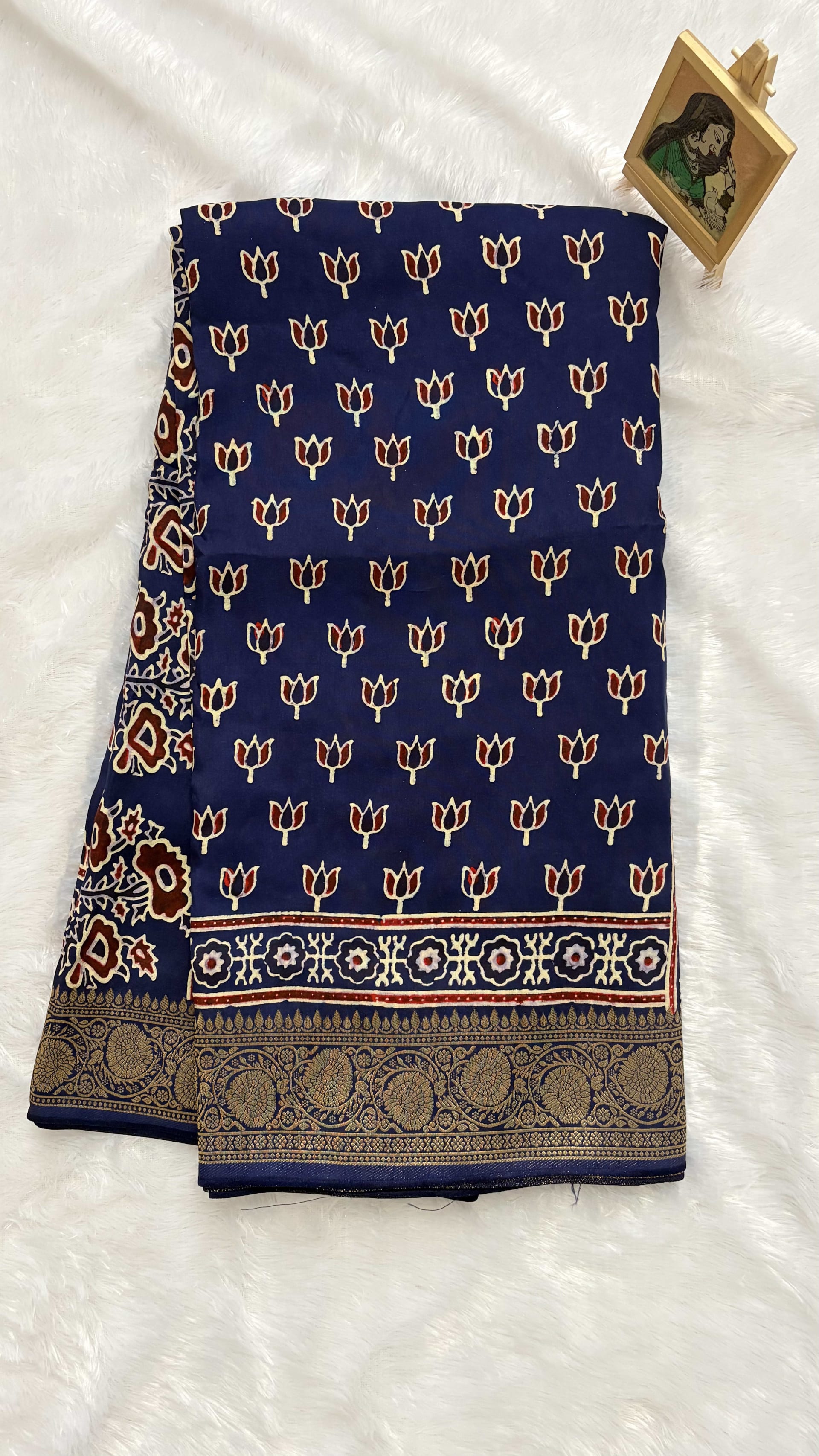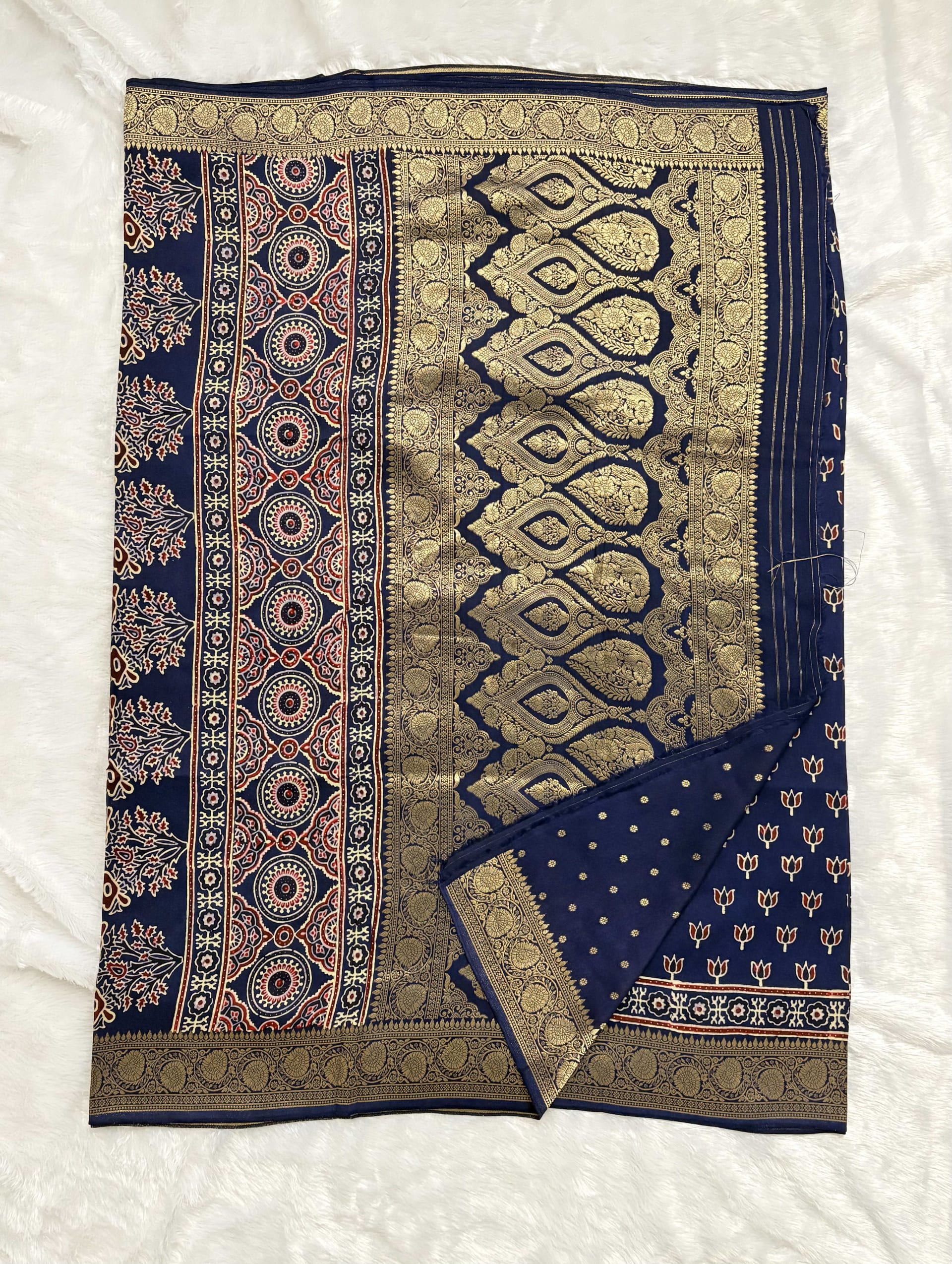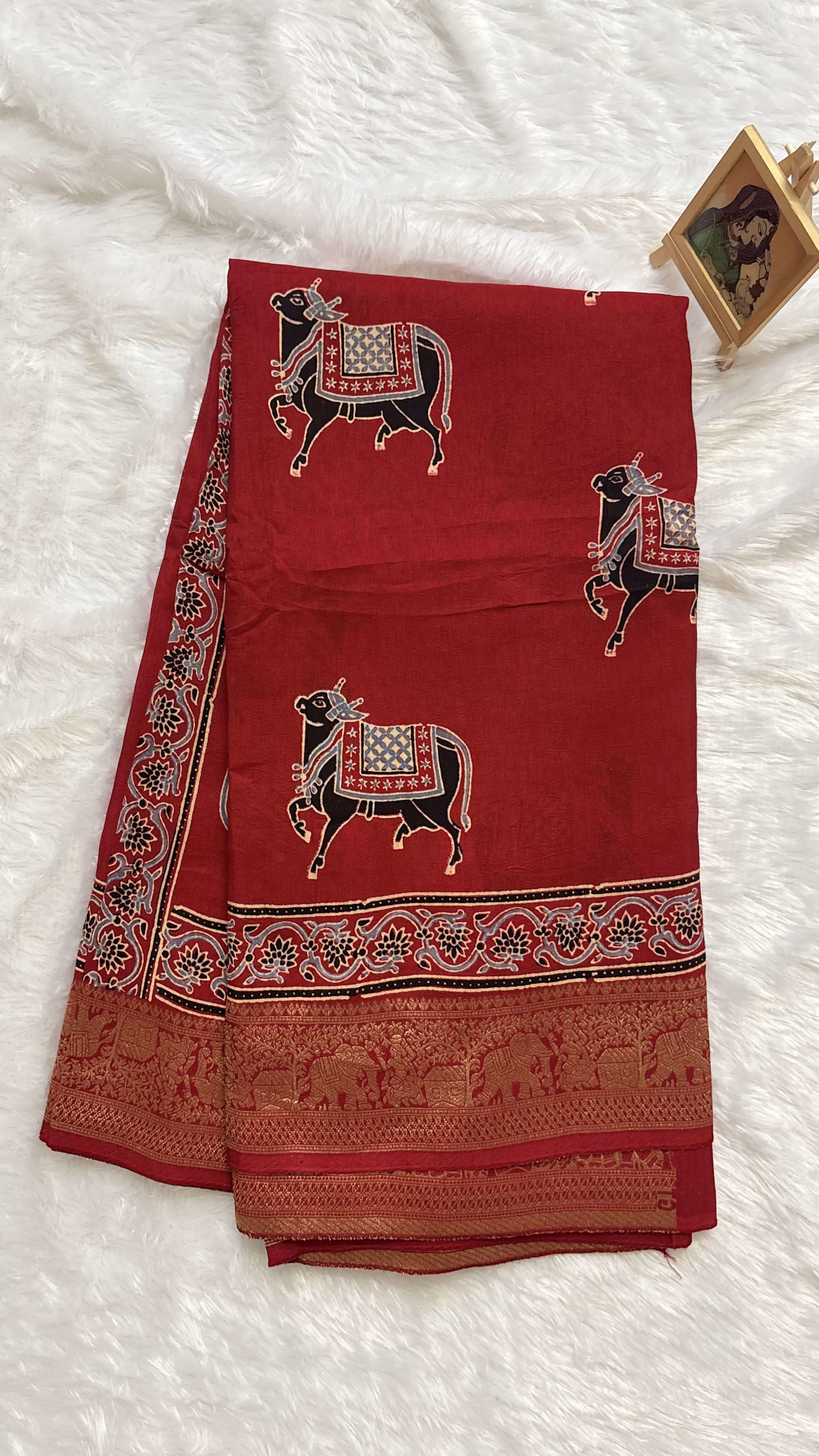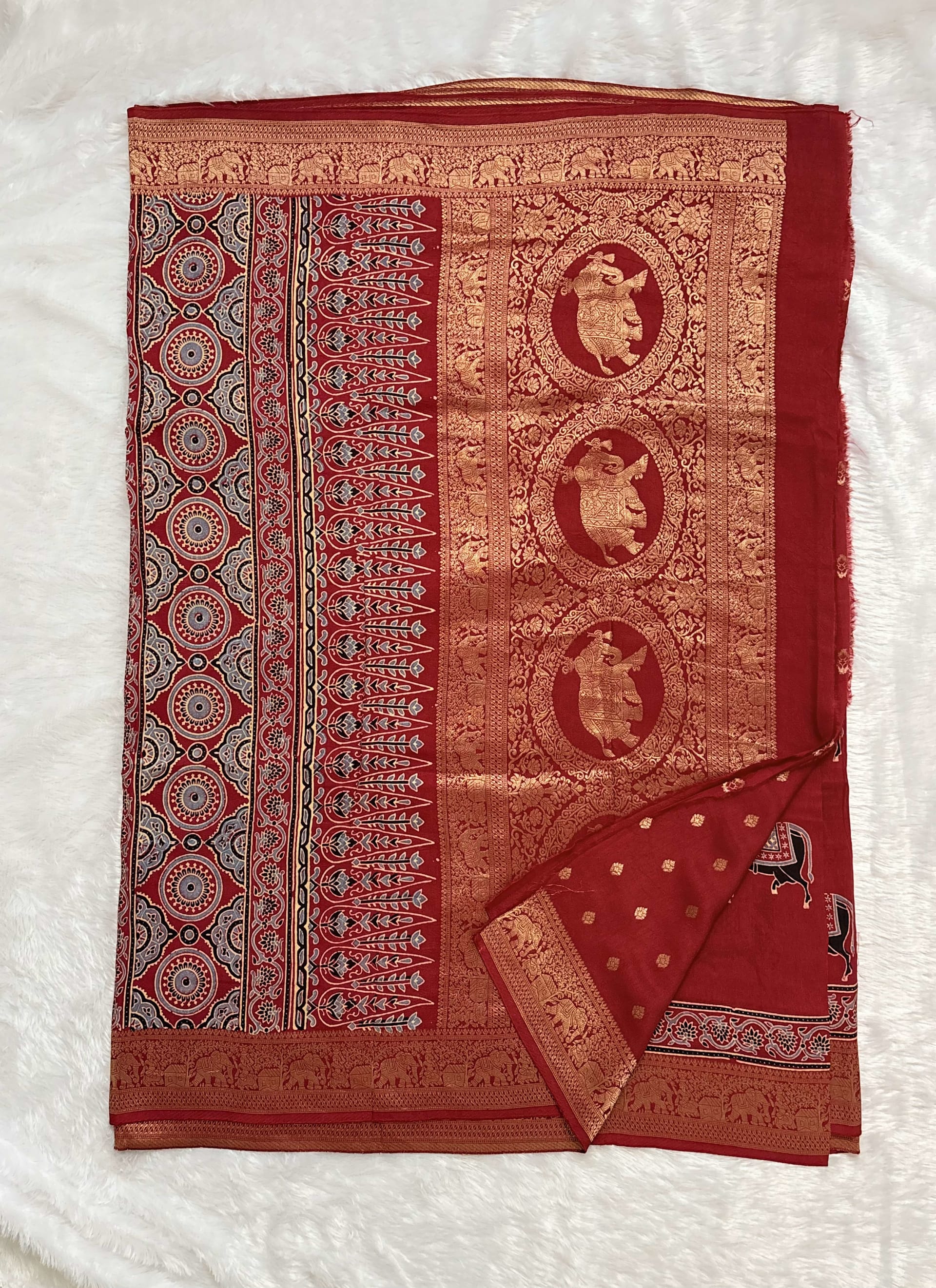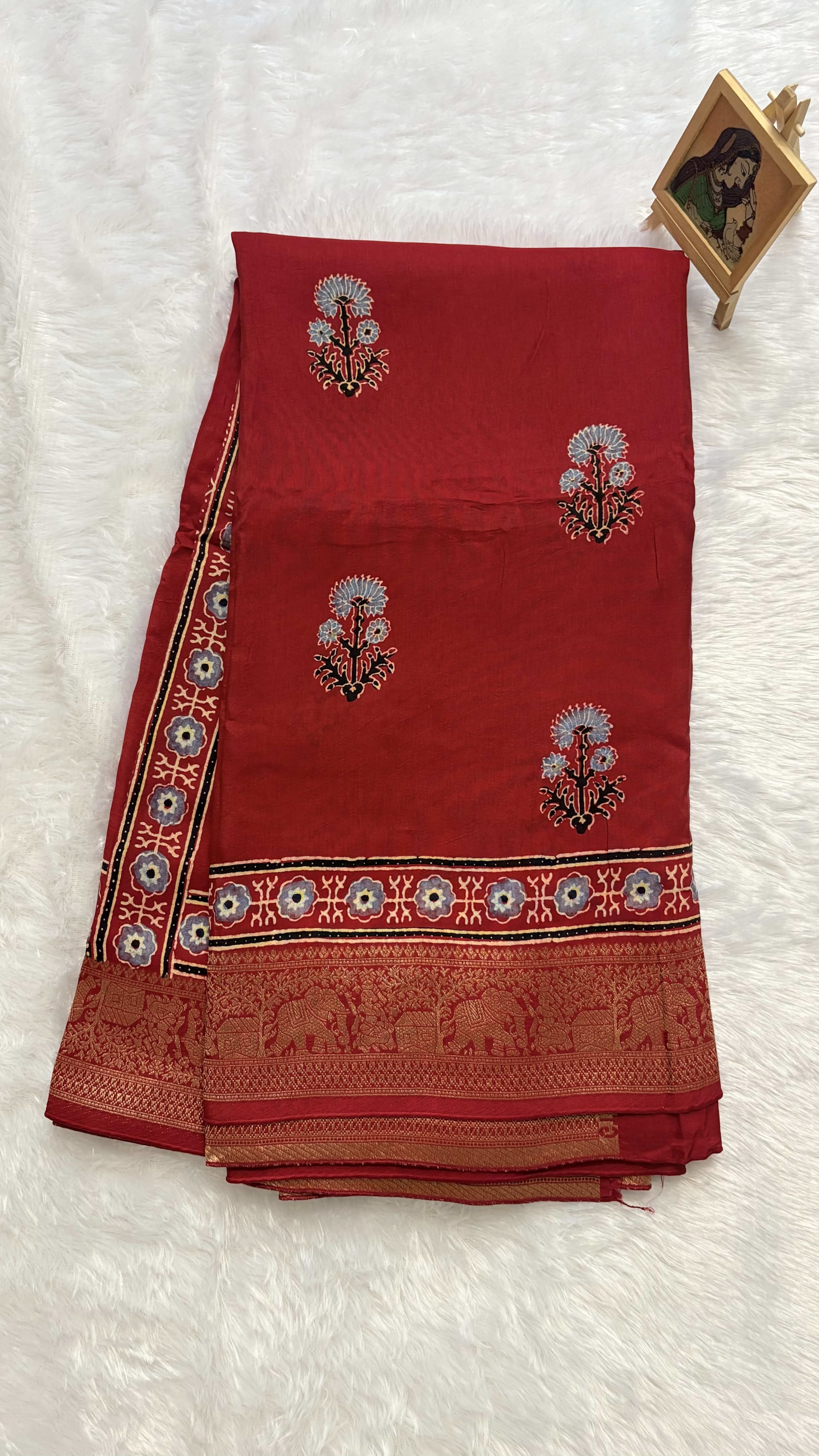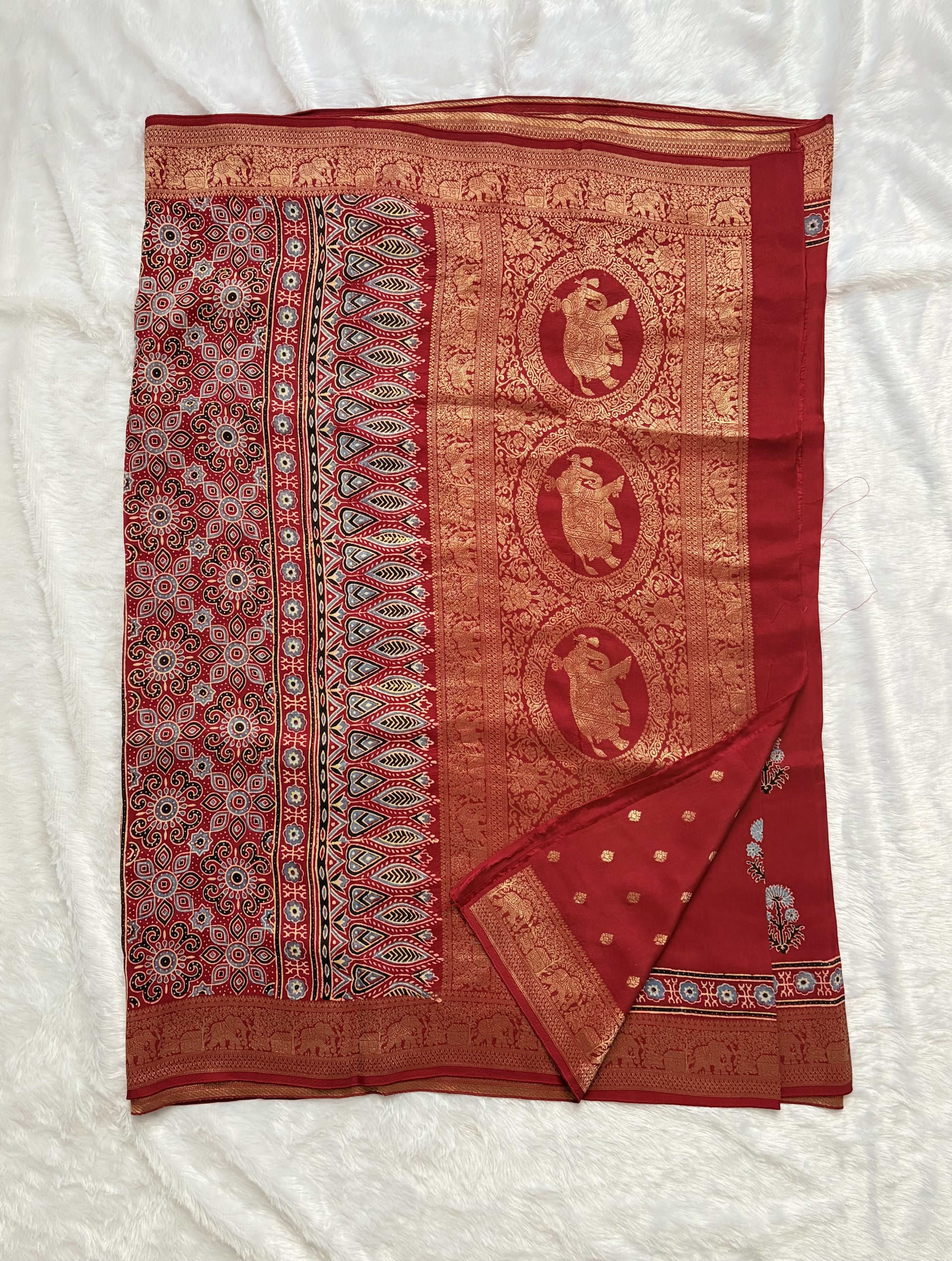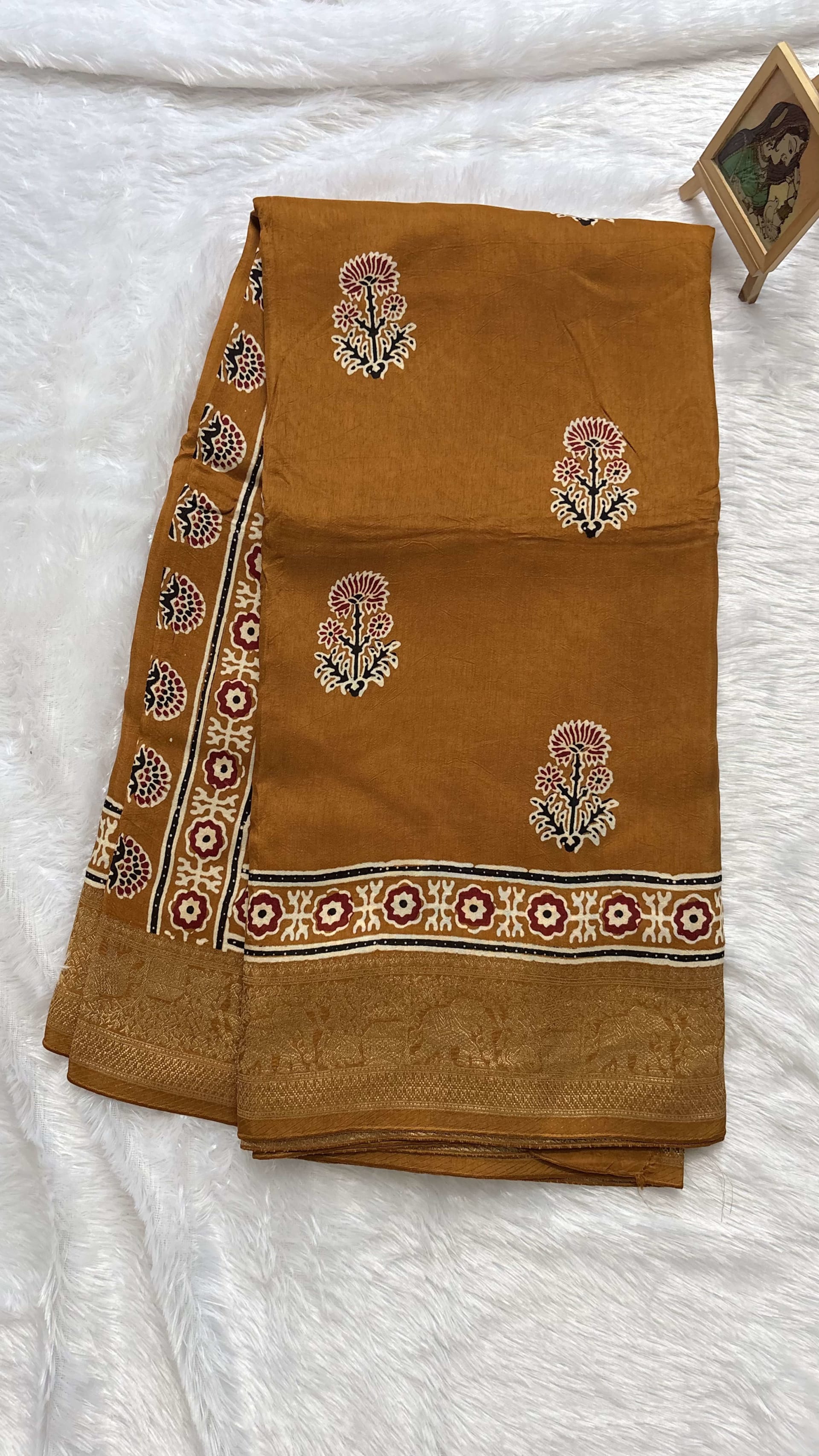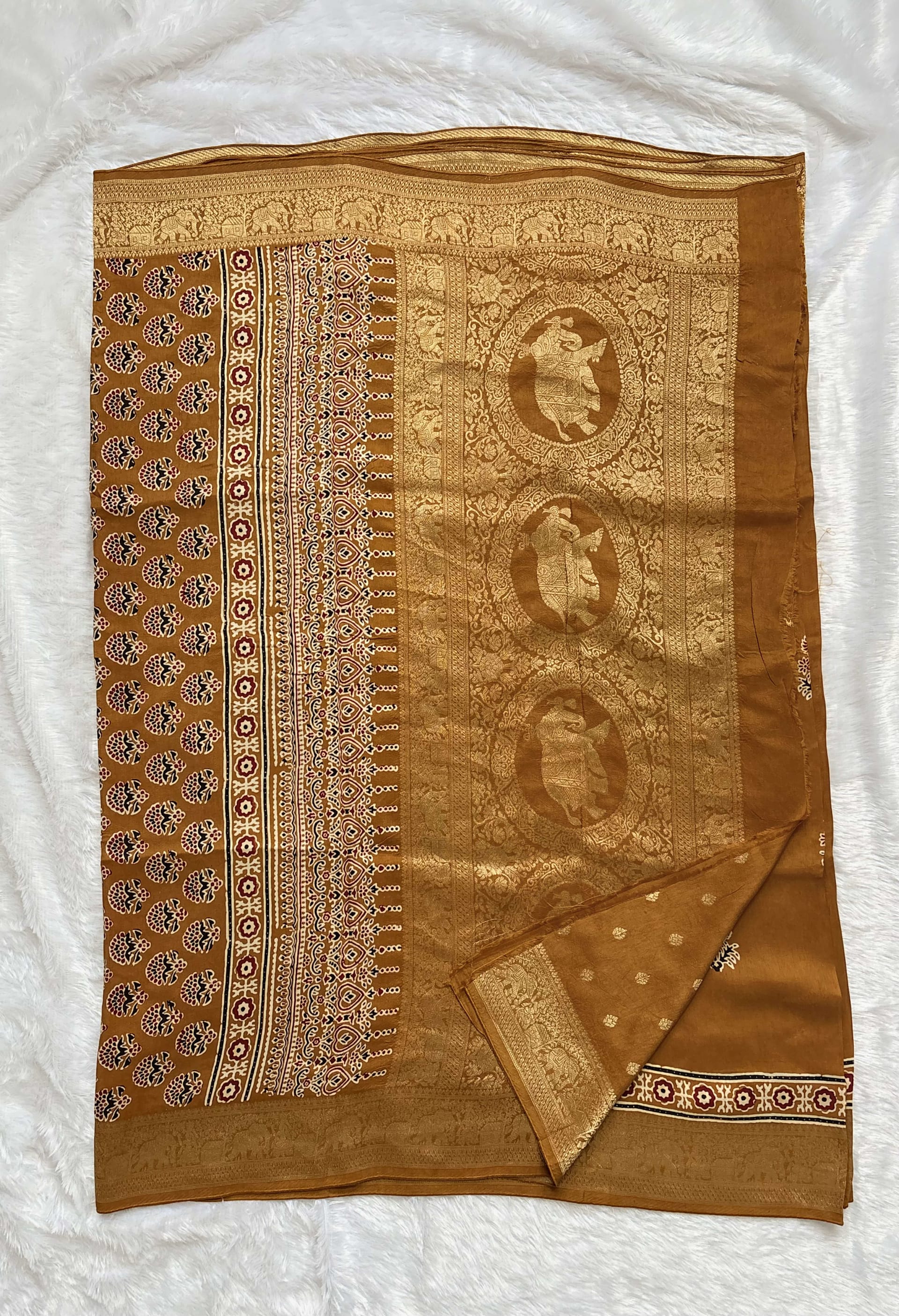
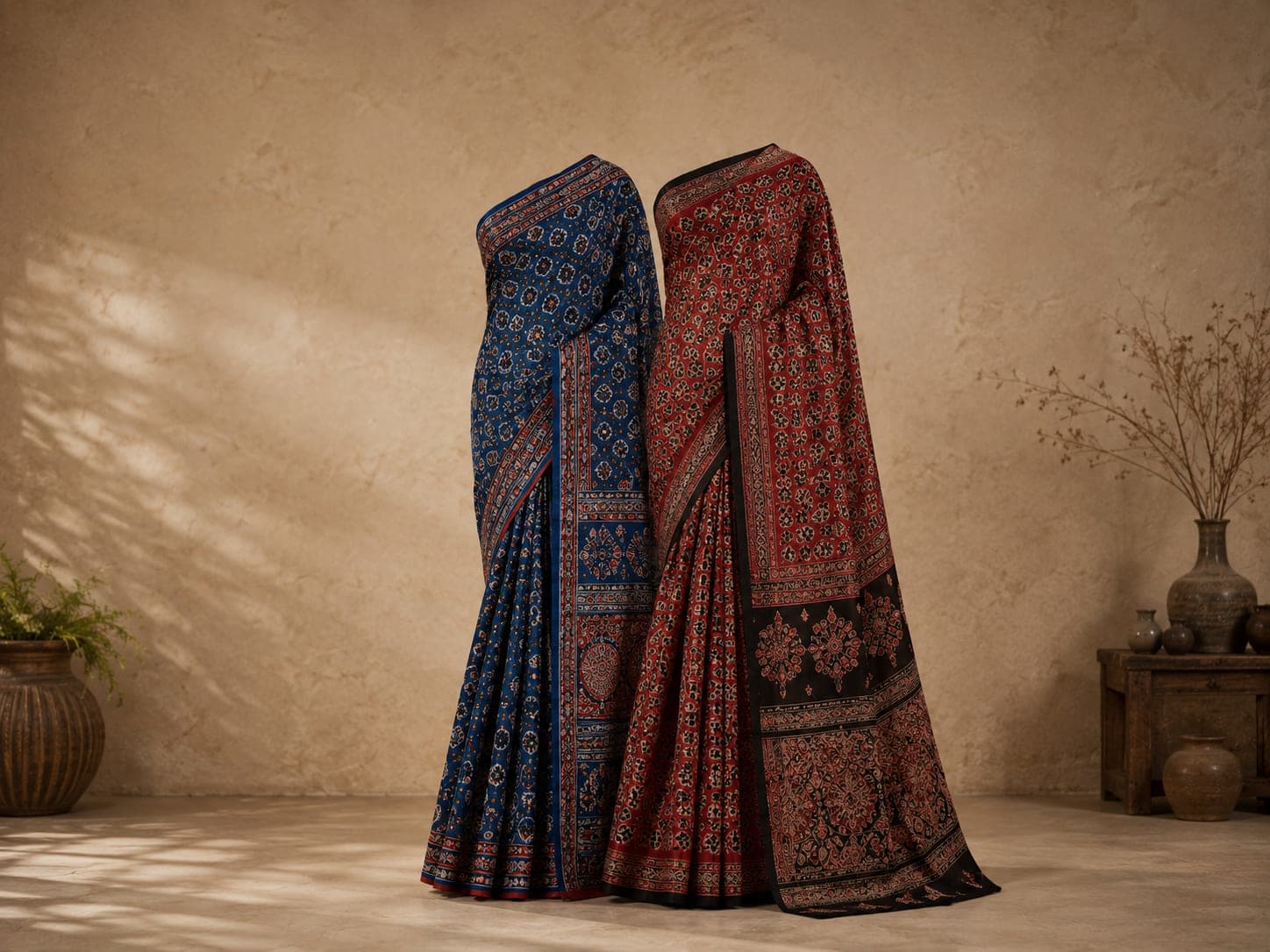
Where it comes from
The name comes from azrak, blue in Arabic, and blue is the point — indigo is the colour the whole process is built around. Ajrakh came to Kutch from Sindh, and has been practised by the Khatri community for something in the order of four hundred years.
After the 2001 Bhuj earthquake destroyed the water supply the printers depended on, a group of Khatri families relocated and founded a new village specifically for the craft. They called it Ajrakhpur. It sits about fifteen kilometres from Bhuj, and the workshops there are the centre of the craft today.
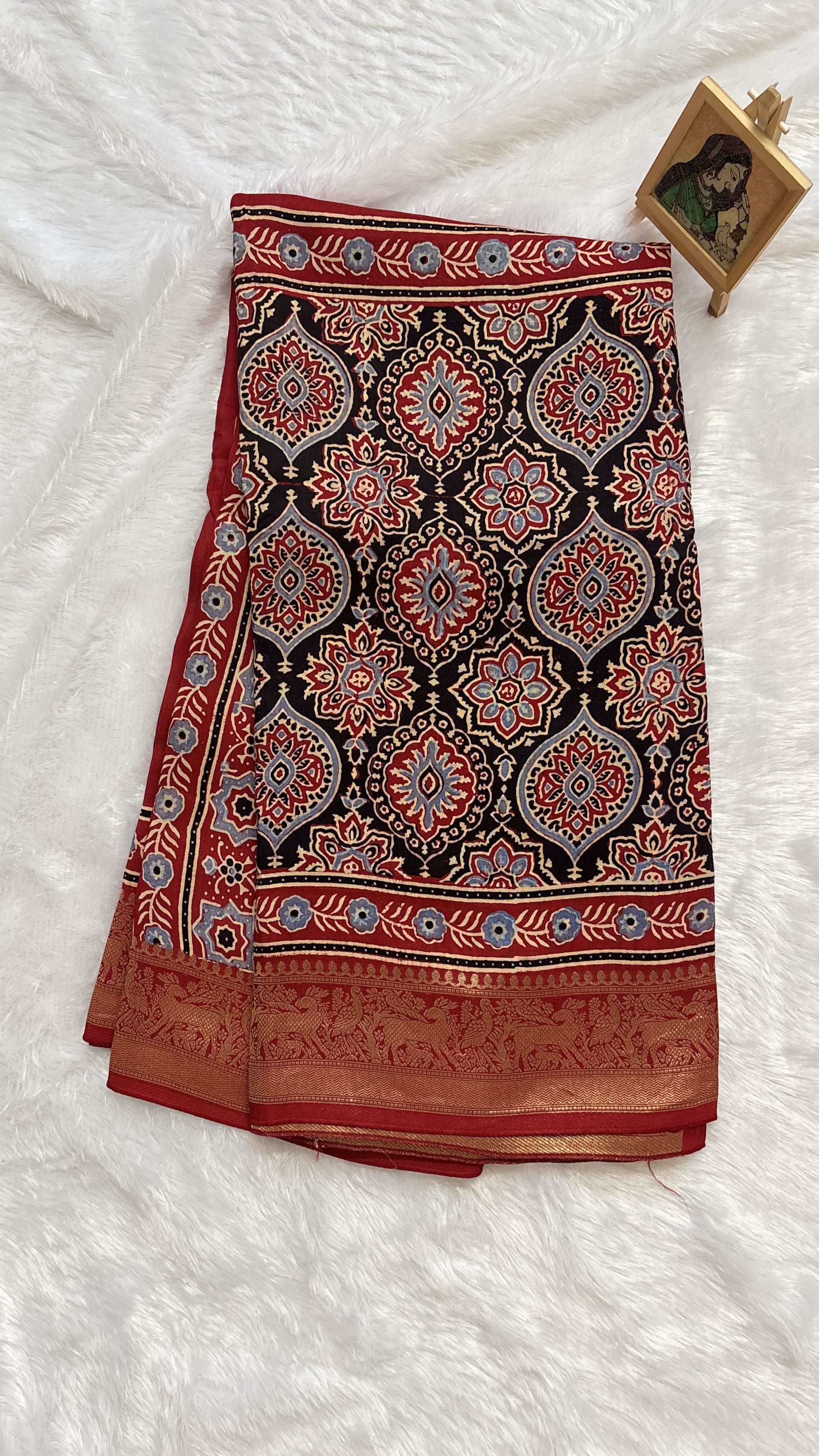
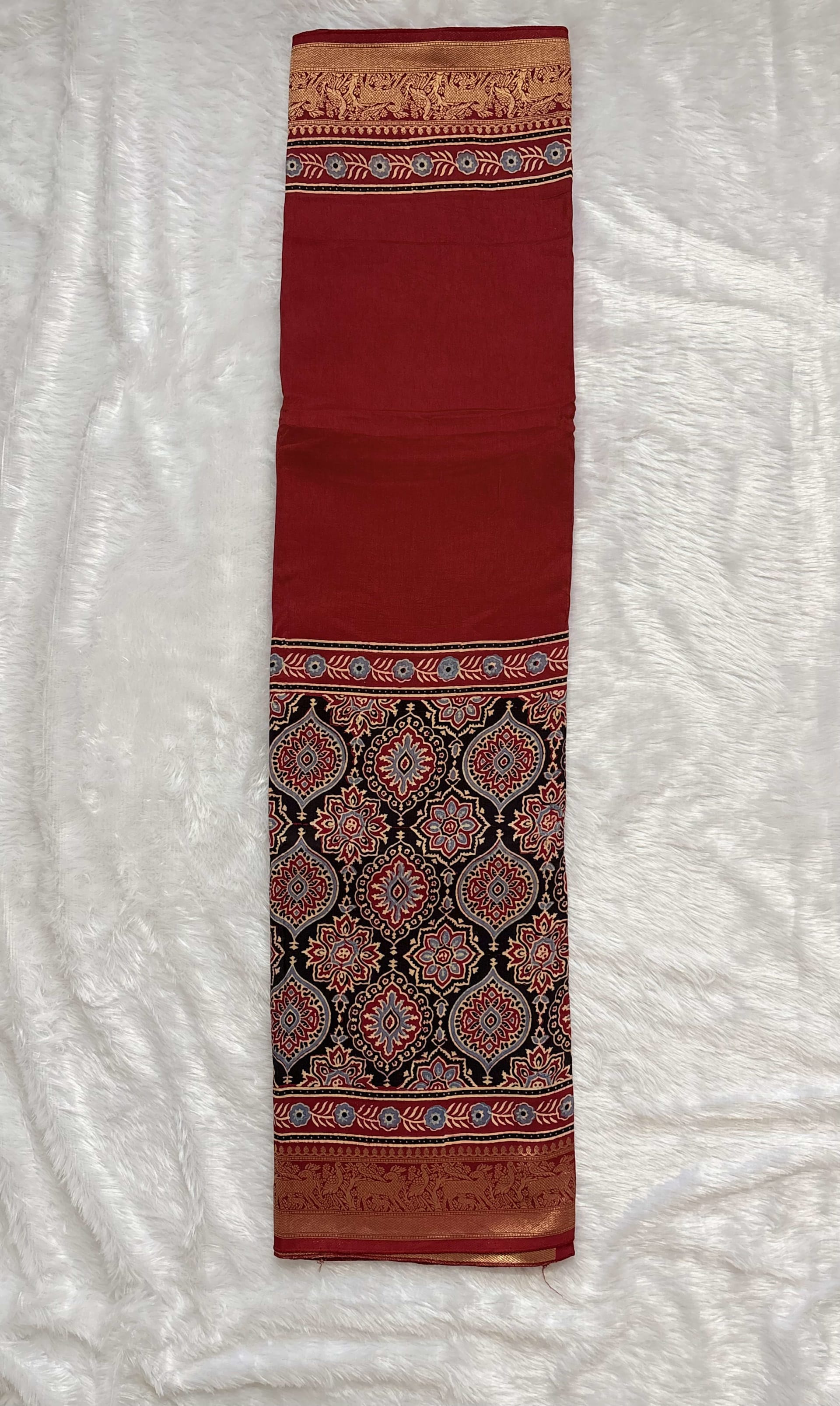
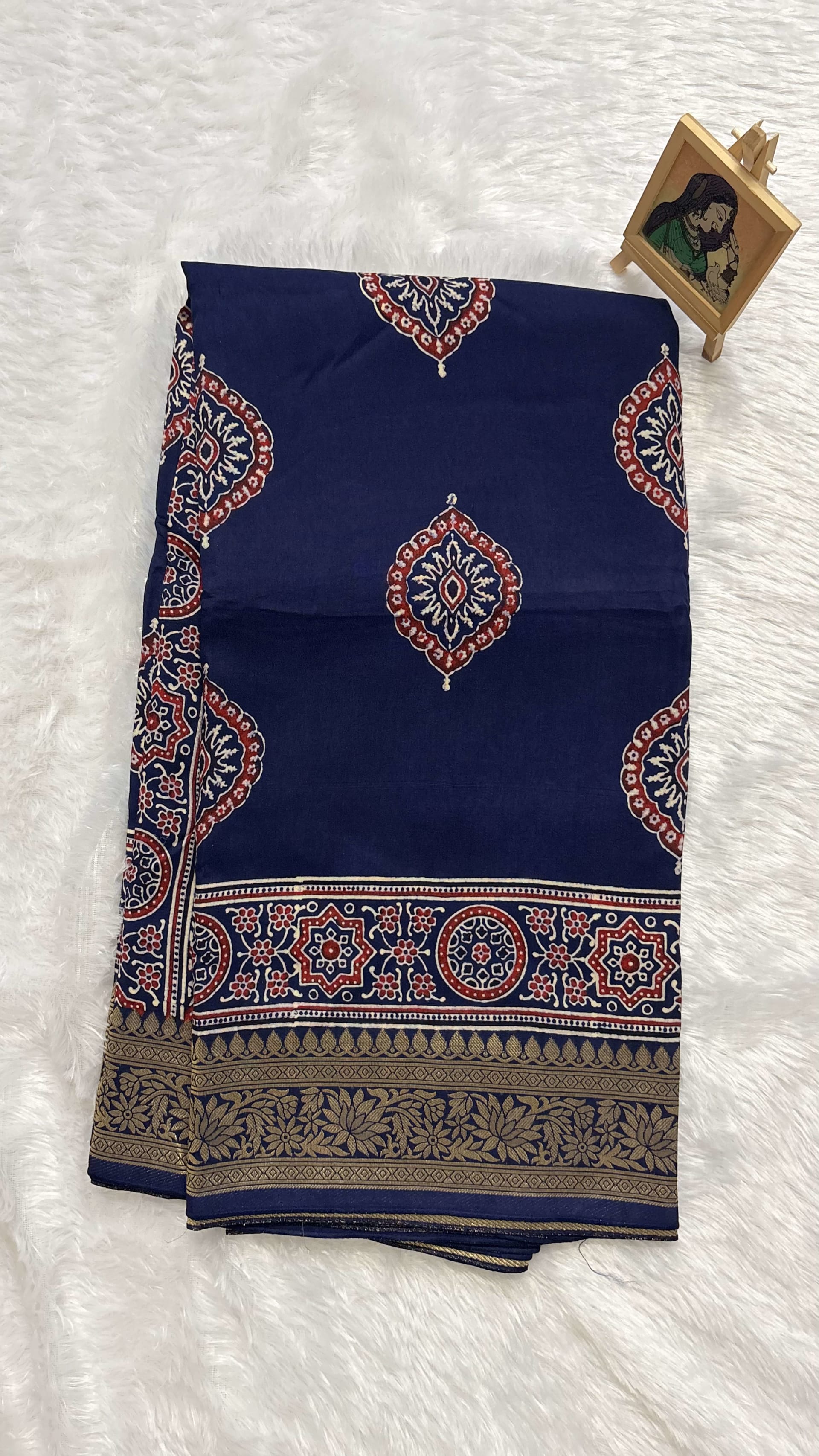
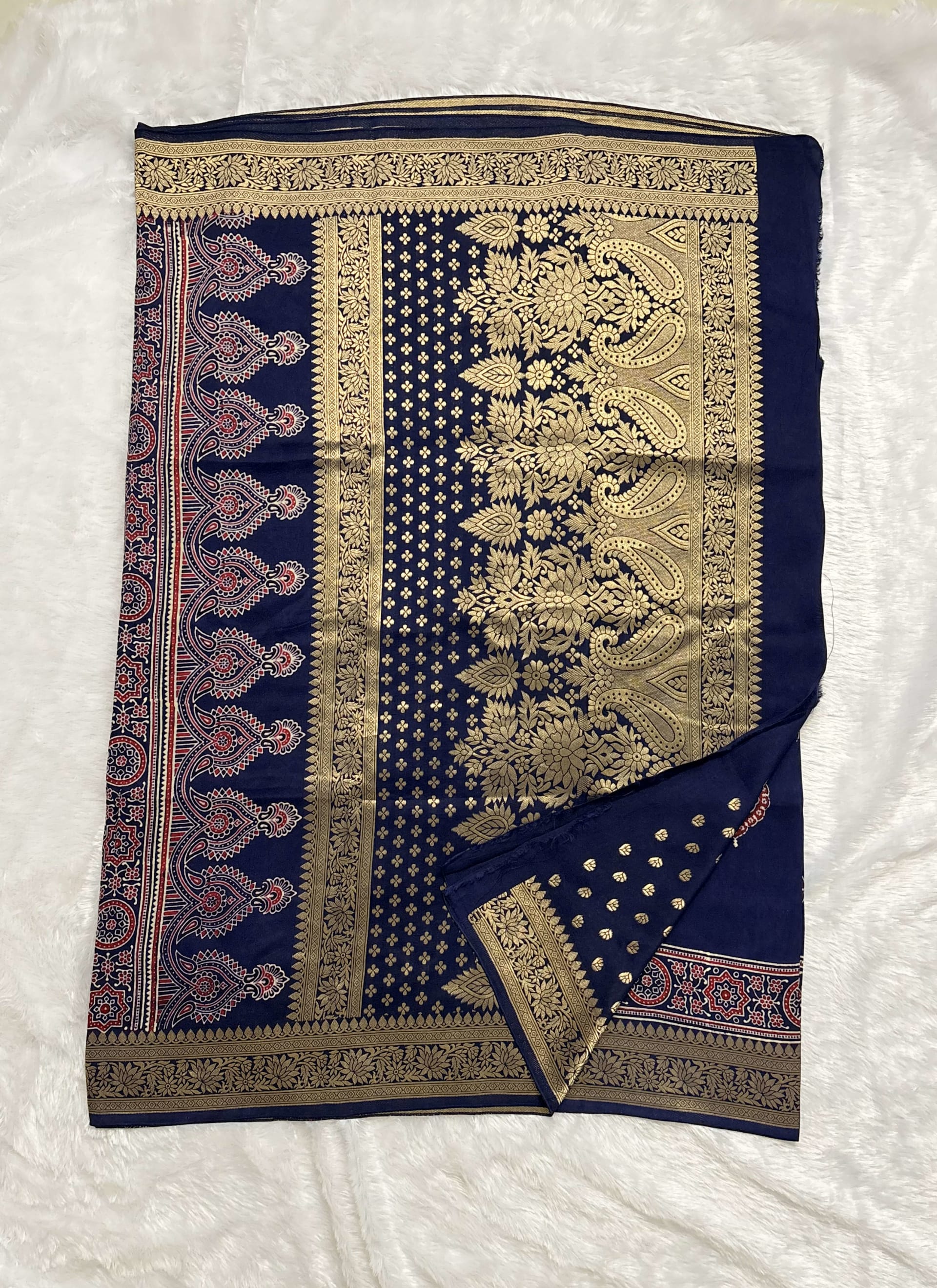
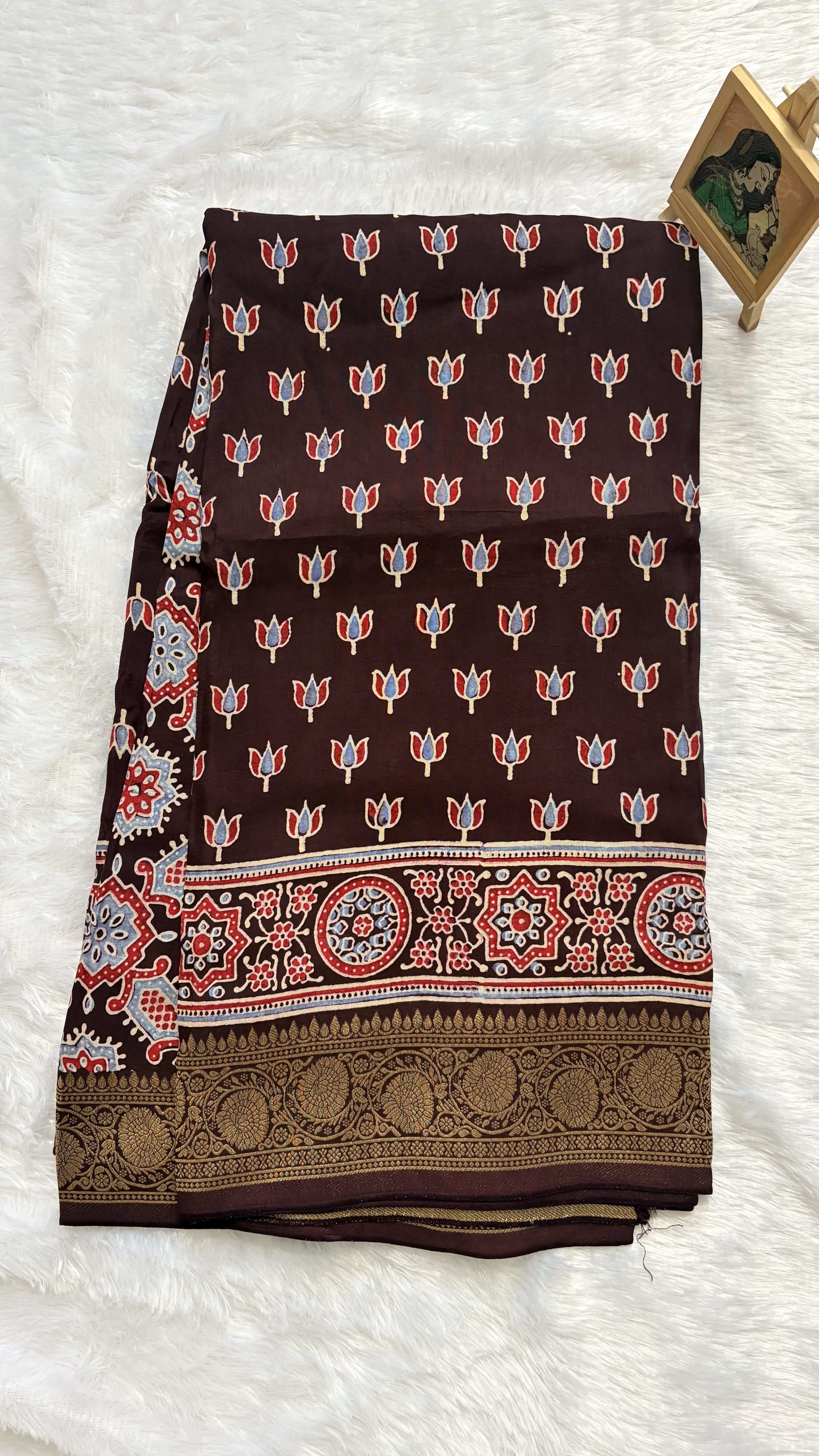
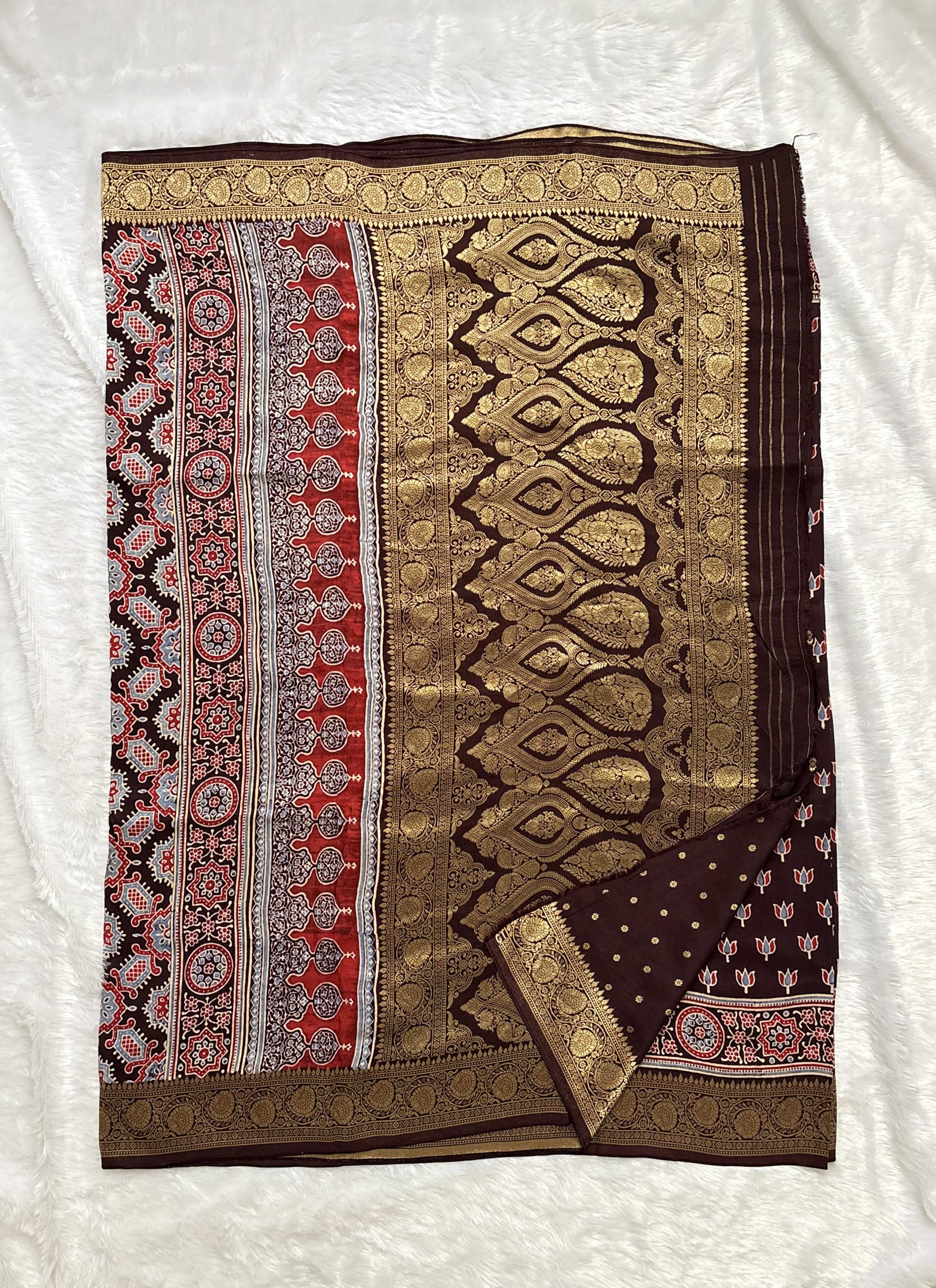
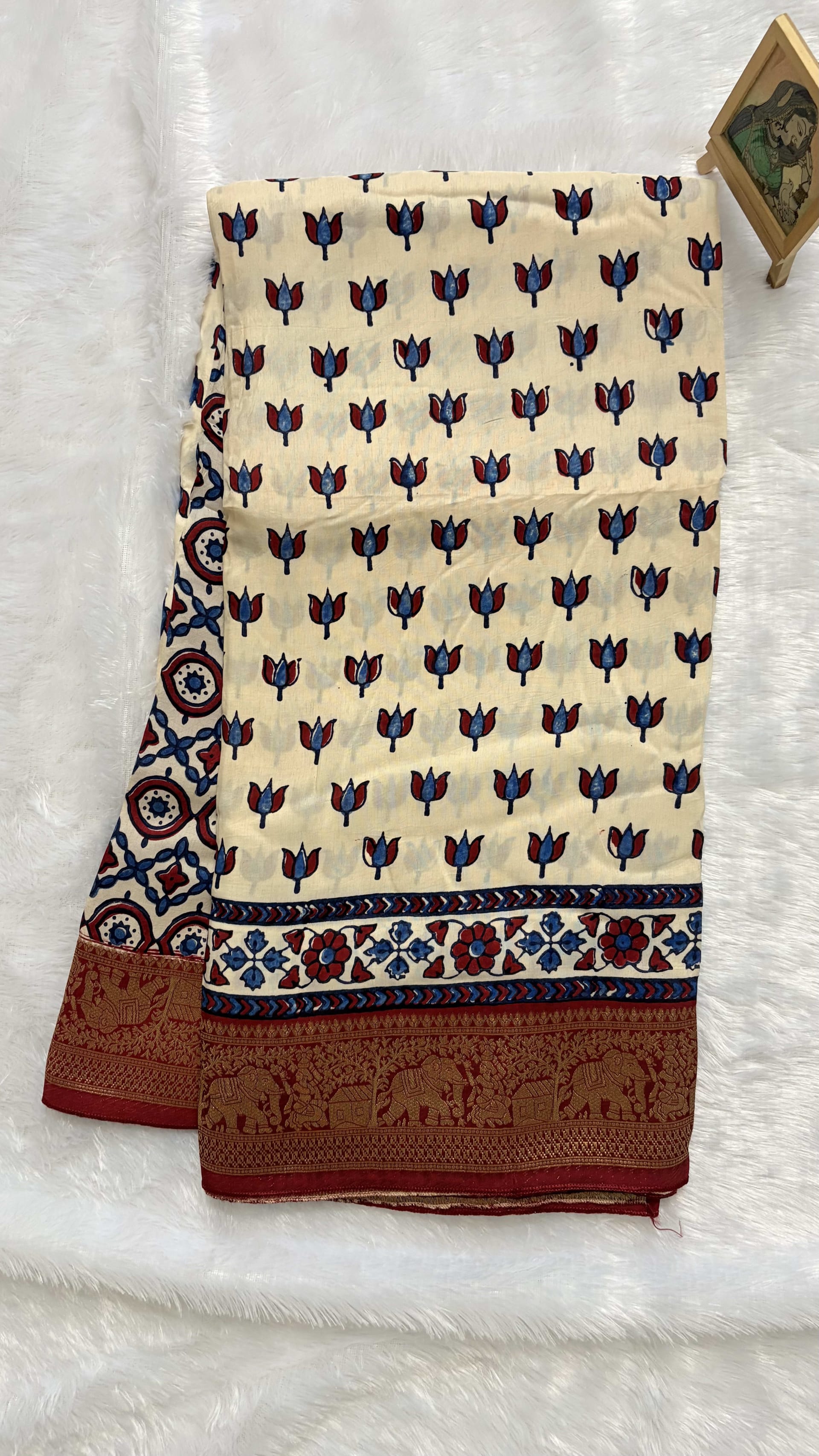
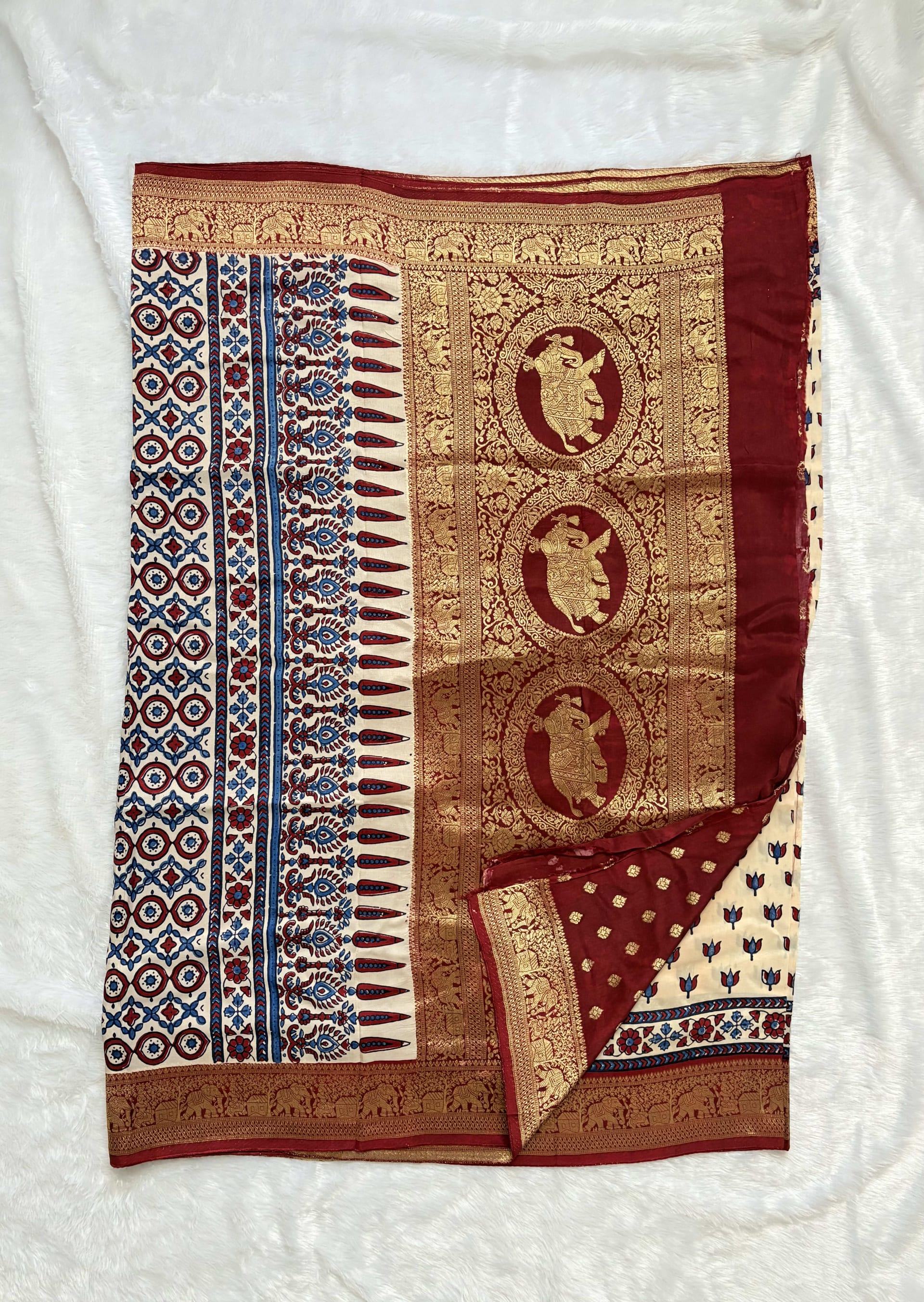
Traditionally Ajrakh was menswear — lungis, turbans and shoulder cloths for the Maldhari pastoralists of Kutch, reversible and printed identically on both faces. Sarees are a more recent adaptation, and the reversibility is the part most often lost in translation. It is worth asking whether a piece is printed on both sides.
How it is made — sixteen stages, about a month
Ajrakh is resist printing, which means the pattern is created by deciding where dye will *not* go. Every colour in the finished cloth is a separate round of printing, dyeing and washing, and the sequence runs to roughly sixteen stages.
Preparation. The cloth is washed repeatedly, then treated with a mixture that includes castor oil and camel dung and left to steep. This sounds like folklore and is actually chemistry: it breaks down the natural waxes in cotton and raises the fibre's affinity for dye. Then a bath of myrobalan — the dried fruit of the harda tree — deposits tannin across the cloth, which is what later lets iron and alum bite.
Resist printing. A thick paste called kharrh, made from gum, rice paste, lime and alum, is printed by hand with carved teak blocks over every area that must stay untouched by the next dye bath. This is the skilled step: the printer is working in negative, placing a substance that will later be washed away, and has to hold the finished image in their head.
Dyeing. Indigo comes from a fermented vat — a living culture kept in sunken clay pots, maintained over weeks. Madder root gives the reds. Iron rust, fermented with jaggery, gives the blacks. None of these are poured on; the cloth is submerged, and only the unresisted areas take colour.
Washing. The cloth is washed up to fourteen times across the process, traditionally in running river water, to strip the resist paste and fix what remains. This is why the craft is so tied to water supply, and why losing it in 2001 meant moving an entire village.
Start to finish, three to four weeks per piece.
How to tell real Ajrakh
Screen-printed imitations of Ajrakh are common, cheap, and from a distance quite convincing. Up close they are not.
Check both faces. Traditional Ajrakh is printed on both sides in register, and even where a saree is single-sided the dye penetrates the cloth thoroughly because it was dyed, not surface-printed. A screen print leaves the reverse markedly paler.
Look for the joins. A block is a few inches across, so a printer covering six metres of cloth has to place it hundreds of times by hand. Look along a border and you will find places where the repeat does not line up perfectly — a hairline overlap, a whisker of a gap. That is the signature of a human arm. A screen print repeats flawlessly.
Look at the colours themselves. Natural indigo has depth and slight unevenness, and reads differently in daylight than under a bulb. Madder red is warm, slightly earthy, never fluorescent. Chemical dyes hit a flatter, brighter, more even note — particularly in the reds, which tend to go pinkish or garish.
Smell it, oddly enough. Naturally dyed and repeatedly washed cloth has a faint, clean, mineral smell. Heavy chemical printing often carries a sharper synthetic edge.
Expect small irregularities. A slightly smudged motif, a faint variation in depth of colour across the length — these are not defects in an Ajrakh, they are the fingerprints of the process. Perfect uniformity is the thing to be suspicious of.
What it should cost, and why
Ajrakh pricing follows the number of colours and the fineness of the blocks. Each additional colour is another full cycle of resist printing, dyeing and washing — so a three-colour piece is not incrementally more work than a two-colour one, it is another week.
The base cloth matters too. Ajrakh on cotton, on mul, on modal, on Gajji silk and on tussar are all made — and the same printing on silk costs considerably more than on cotton before a single block is laid down.
The blocks themselves are worth understanding as a cost. They are hand-carved from teak, they wear out, and an intricate one represents weeks of a carver's work. Finer detail in the print means more blocks, more passes, more registration risk.
Living with Ajrakh
Natural dyes are alive in a way synthetic ones are not, and they will shift slightly over the years. Indigo softens. This is normal and, to most people who love the craft, part of the appeal.
Wash separately the first two or three times, in cold water, by hand, with a mild soap — not detergent. Some excess dye will come away. That is the unfixed surplus leaving, not the pattern failing.
Dry in shade, never in direct sun. Sunlight is what fades natural dye fastest, and a saree dried repeatedly on a sunny terrace will lose its depth within a couple of seasons.
Skip the harsh stain removers and anything with bleach entirely. Bleach will strip indigo instantly and there is no way back.
Ajrakh on cotton genuinely improves with wear — it softens, the drape relaxes, and the colours settle into each other. This is one of the few textiles where a five-year-old piece can be nicer than a new one.