Kutch, Jamnagar, Marwar, Shekhawati
Bandhani belongs to two states, and the traditions in them are genuinely different.
In Gujarat the centres are Kutch, chiefly Bhuj and Mandvi, and Jamnagar in Saurashtra. Craft documentation records bandhani arriving in Jamnagar at the founding of the city. Local dyers have long held that Jamnagar's water brings out the brightest red of anywhere in India, which is a claim of long standing rather than a measured one, and it has done the town no harm at all.
Rajasthan works it in Jodhpur, Barmer and Pali in Marwar, in Udaipur and Nathdwara in Mewar, in Sikar, Jhunjhunu and Churu in Shekhawati, and in Bikaner. Each district keeps its own patterns and its own names for them. That is one reason two sarees sold under the same word can look almost nothing alike.
The craft is carried by the Khatri community, who brought it to Kutch from Sindh. The Kutch craft centre Khamir dates the tradition there to the twelfth century. Both Hindu and Muslim Khatri families work in it, and many can trace five or six generations in dyeing.
By the eighteenth century, squares of the stuff were going to Europe as bandannas through the English East India Company. That is where the English word comes from.
The word bandhani protects nothing
Be precise about Geographical Indication status, because sellers rarely are. There is no single GI for bandhani. There are three separate place-linked registrations.
Jamnagari Bandhani was filed by the Jamnagar Chamber of Commerce and Industry in 2010 and certified on 10 November 2016. Jodhpur Bandhej Craft, from the Khanda Falsa area of Jodhpur, was filed in 2021 and certified on 1 August 2023. Kutch Bandhani of Gujarat, applied for by the Kachchhi Khatri Bandhani Hastkala Association, was filed in April 2021 and registered on 30 March 2024.
So the bare word carries no protection whatsoever, and a listing that leans on it is leaning on air. Only the place-linked names are registered, and only registered users may claim them. Ask which of the three a piece is claiming. The answer, or the lack of one, tells you plenty.
Pinch, bind, dye, wait, repeat
The base cloth is thin and open so that the tying does not fight it: malmal or muslin, voile in 80/100 or 100/120 count, georgette, or silk.
The design goes on first in fugitive colour. A thin plastic sheet pierced with pin holes is laid over the cloth and the pattern is pounced through it, leaving a grid of marks that will wash out. The cloth is usually folded in two or four before tying, so one pass of the hands produces mirrored repeats. Two layers halve the tying, four layers quarter it, and the mirror symmetry that results is one of the things you can look for later.
Then the tying, which is where the months go. The worker pinches up a tiny point of cloth and winds thread tightly round it to form a knot, called a bhindi. The thread runs continuously from knot to knot without being cut. Rajasthani tiers grow the nail of the little finger long or wear a small metal ring with a point to lift the cloth. Gujarati tiers often prefer bare hands, on the grounds that the cloth takes less damage that way. The work is done mostly by women. Khamir records contemporary pieces carrying as many as one lakh ties, which is worth sitting with for a moment before anyone calls a hand-tied saree expensive.
Dyeing runs light to dark. The cloth is washed to remove the marking, dipped in napthol, then given a first light colour, usually yellow, for a couple of minutes. It is rinsed, squeezed and dried. More knots are then tied to protect the shade just set, and the cloth goes into a darker bath, where it sits for three to four hours with every knot still closed. Multi-colour pieces repeat that cycle several times over.
After the last bath the cloth is washed, sometimes starched, and dried. Only then are the folds pulled apart to release the knots.
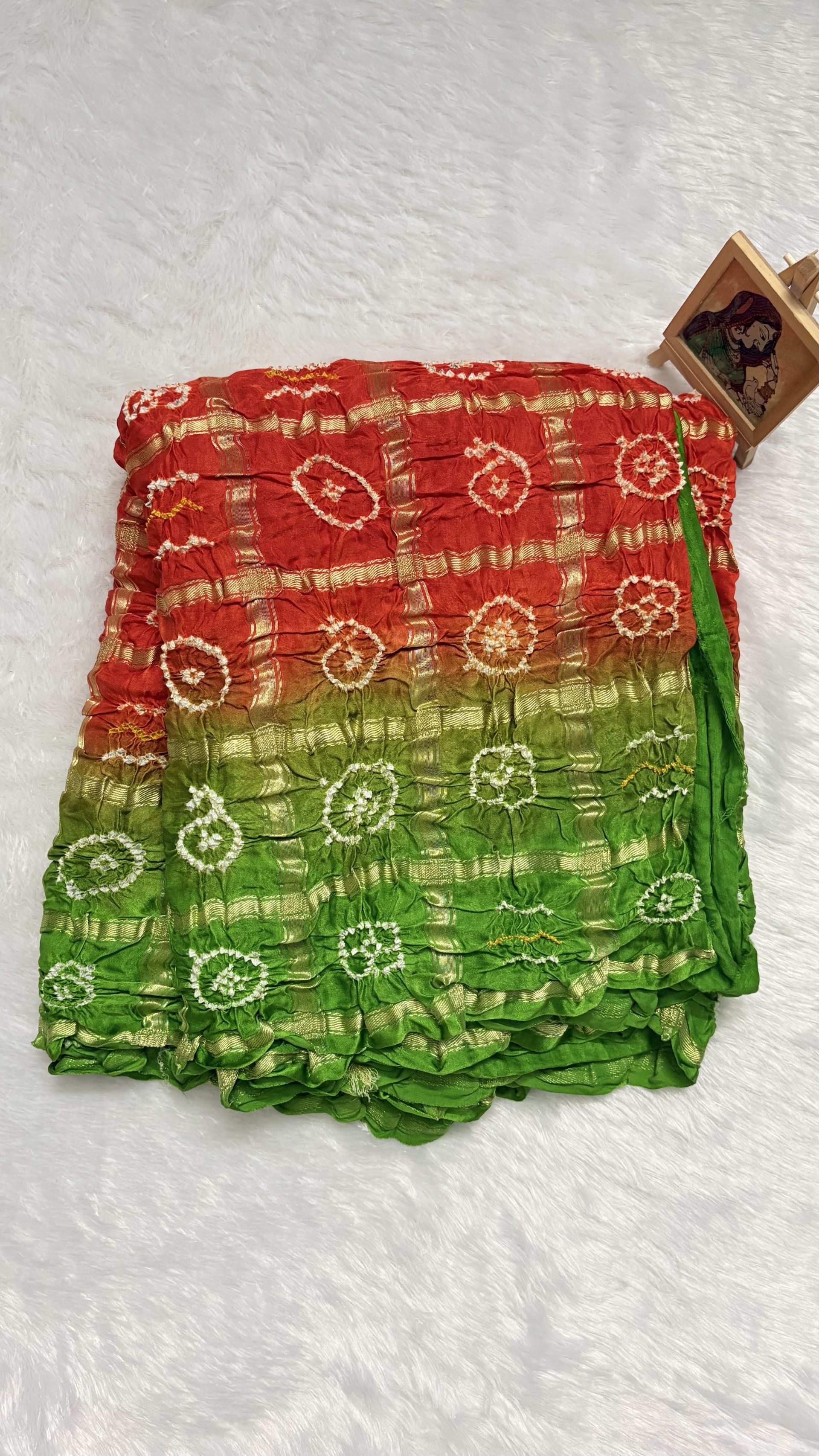
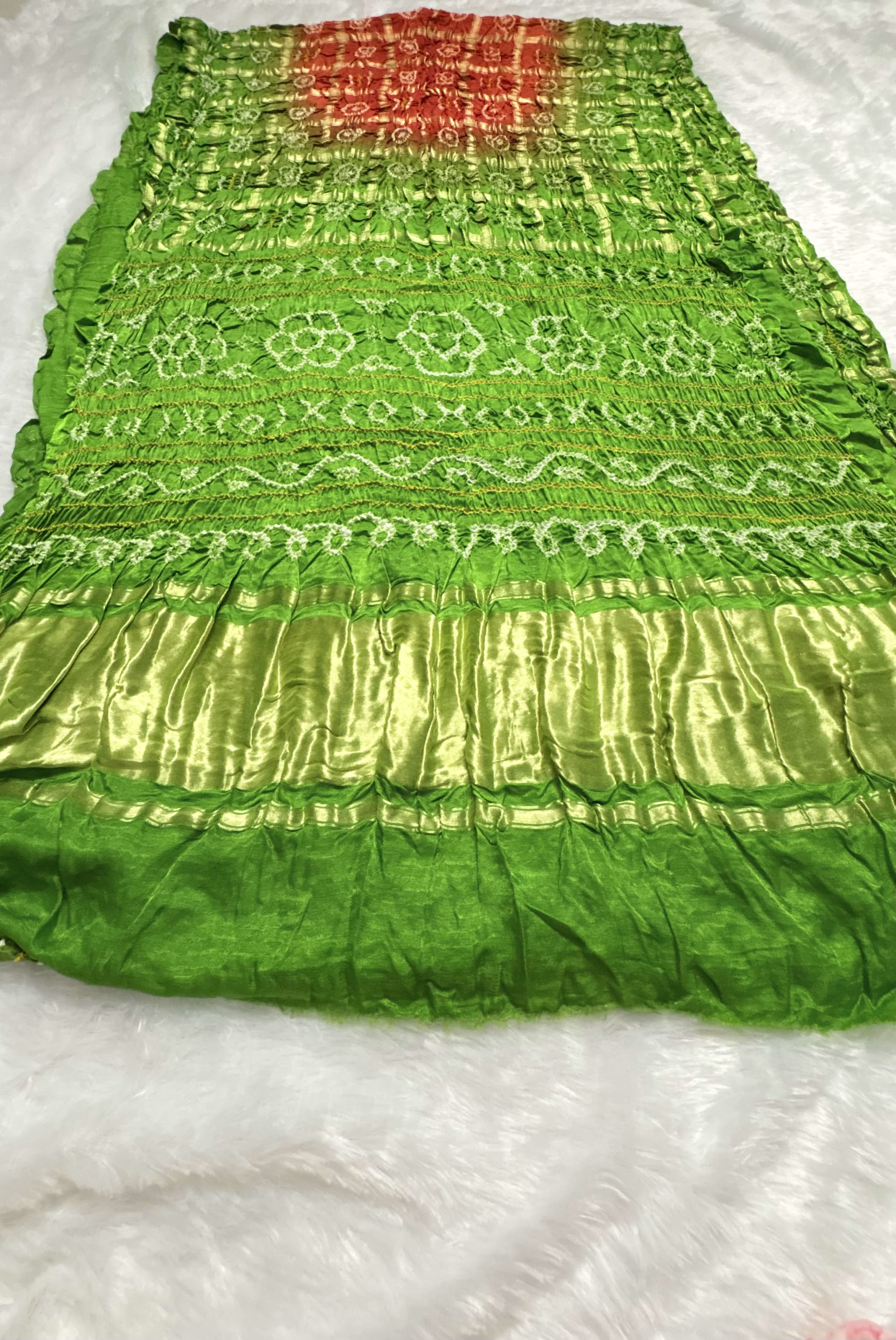
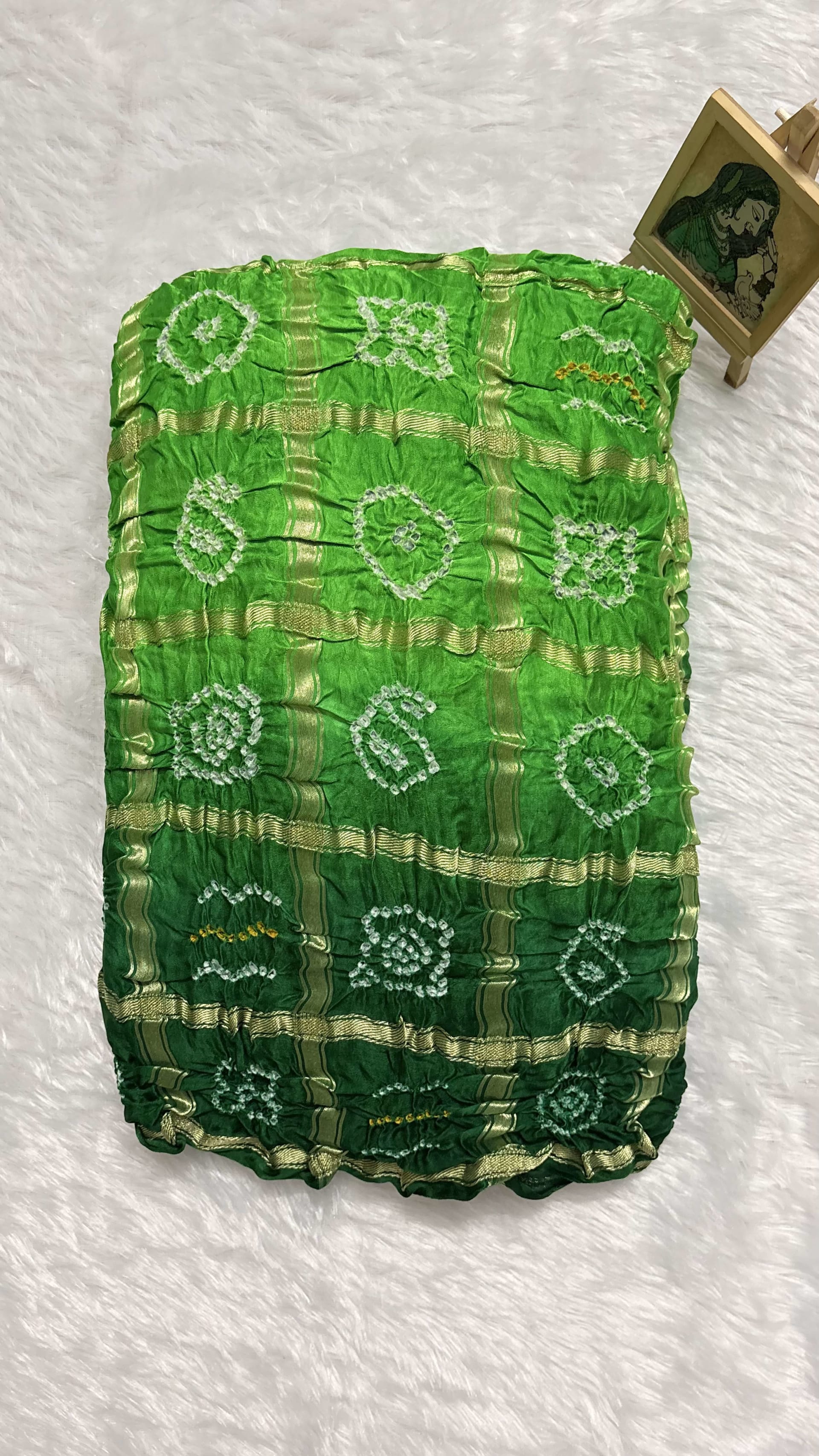
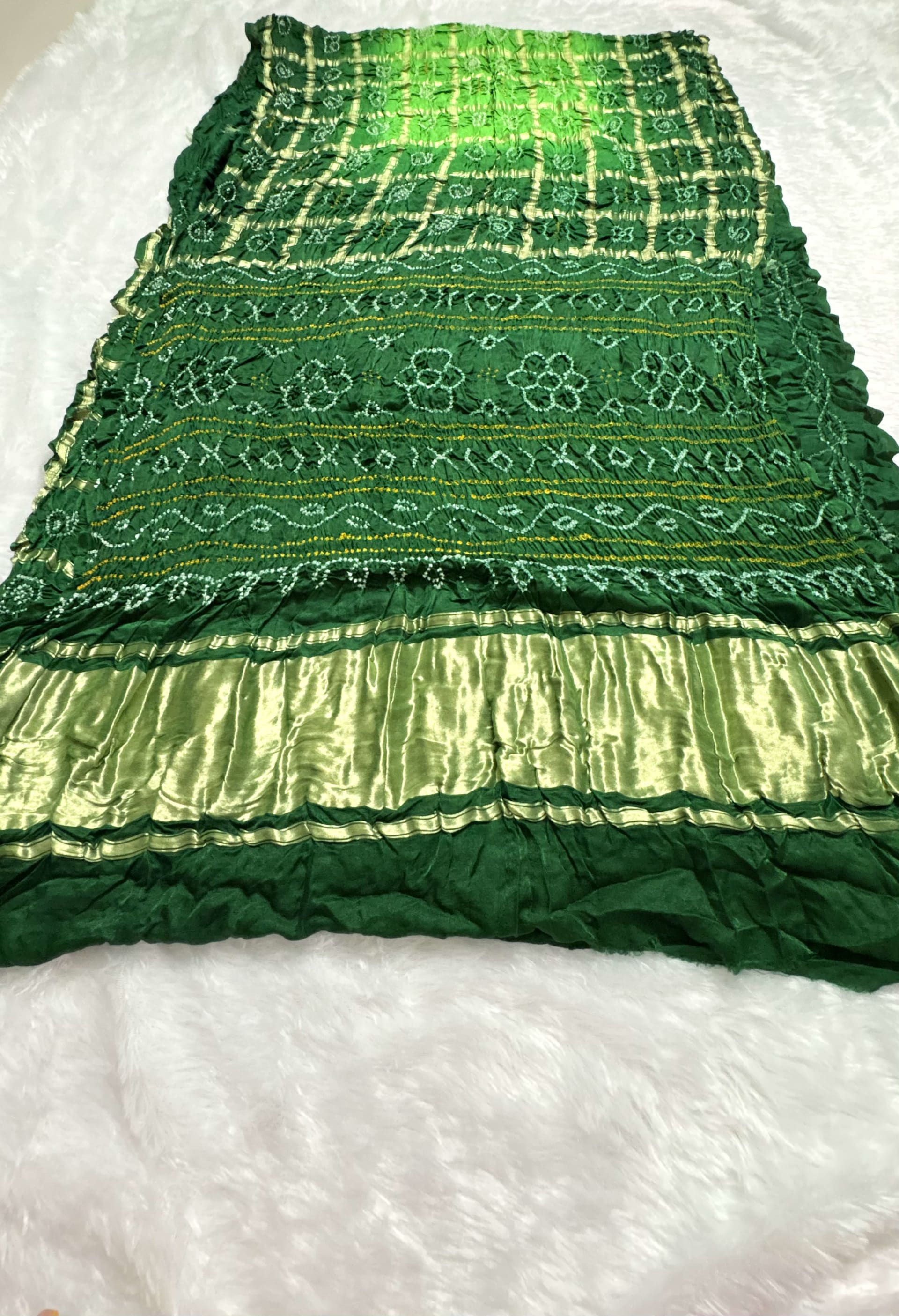
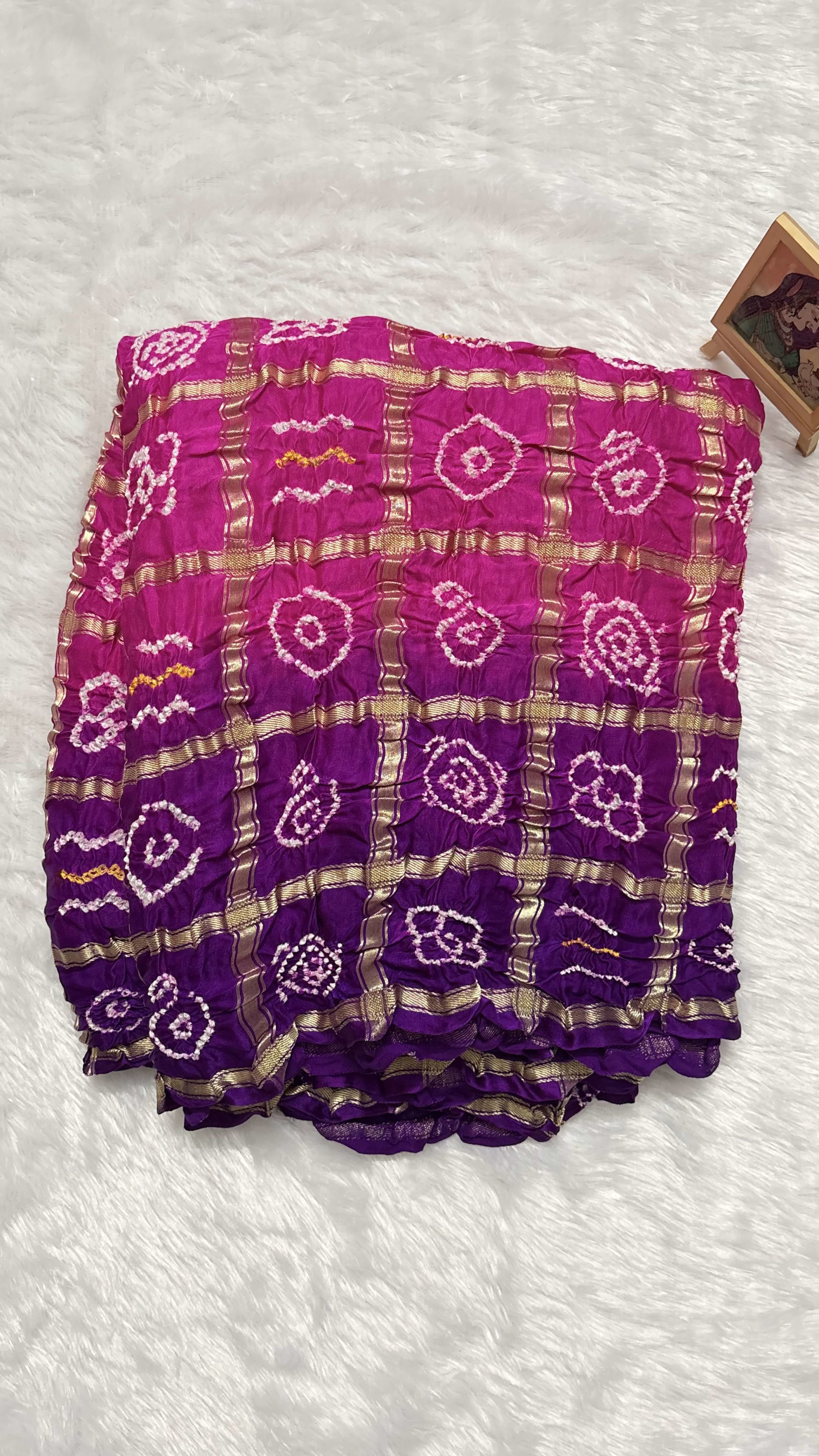
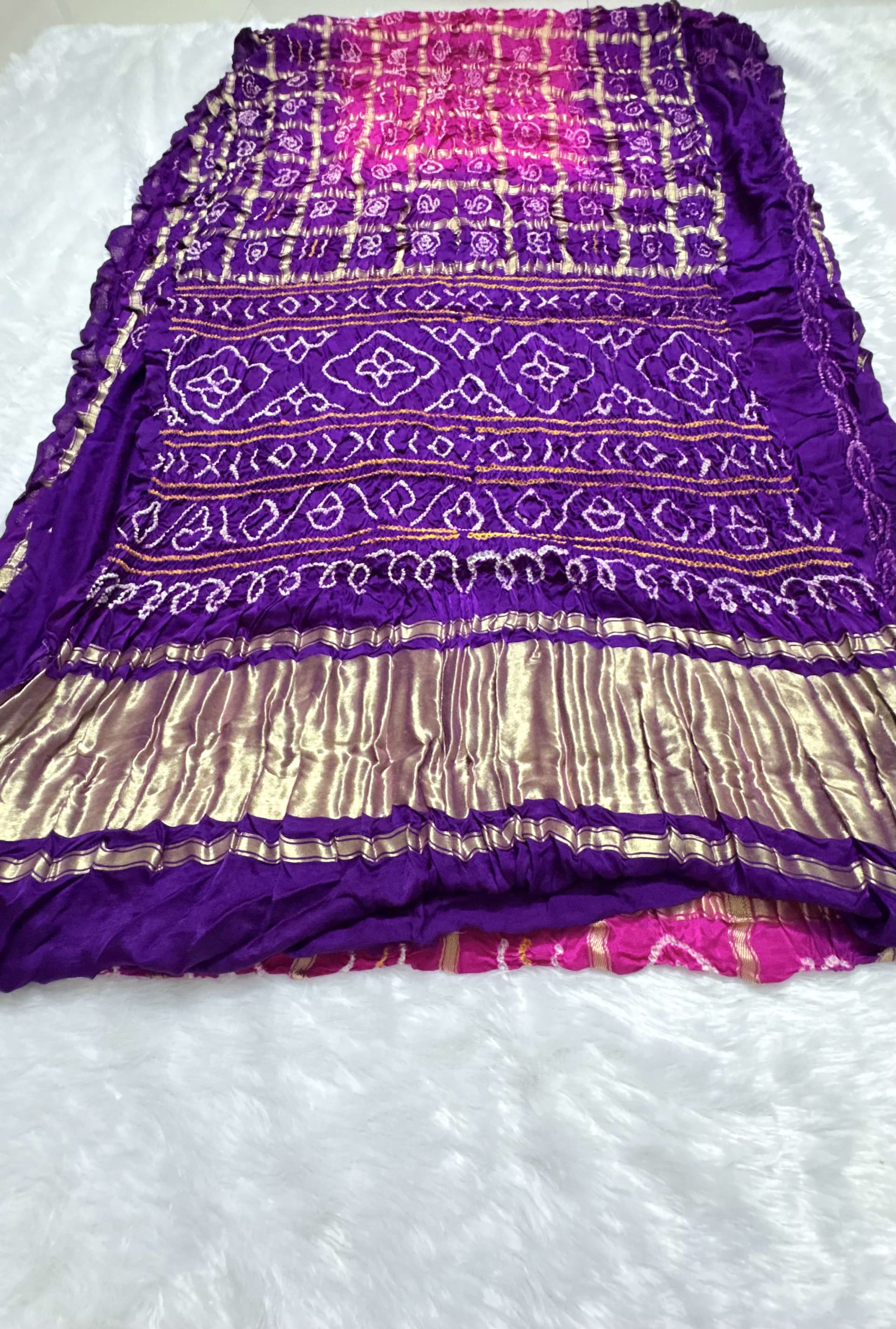
Learn a little of the vocabulary and you can read a saree off the shelf. Ekdali is a single dot, trikunti three, chaubundi four, satbandi seven. A boond is a dot with a dark centre, a kodi is teardrop-shaped, laddu-jalebi is the swirl, dungar-shahi the mountain pattern. Composite layouts include shikargah, jaaldar and beldaar. Colour carries meaning of its own: red for a bride, a yellow ground for a woman who has recently given birth.
One honest note on dyes. Madder and pomegranate were standard until the 1956 Kutch earthquake, after which chemical dyes largely took over. Natural-dye bandhani exists and is being revived, but it remains the exception. Anyone implying otherwise across a whole shelf of stock is overselling, and the romance of madder and pomegranate gets used to justify a lot of prices it has nothing to do with.
Turn it over. That is the whole test.
Screen-printed bandhani is everywhere and it is cheap. Plenty of people wear it knowingly, and there is nothing wrong with that. The problem is only when a print is sold as hand-tied, and the checks that settle it take about a minute.
Turn it over. Tie-dye colours the cloth right through, so on a genuine piece the reverse carries the same dots at close to the same strength as the front. A screen print sits on the surface, and its back is pale, blurred or blank. Fold the saree so front and back sit side by side and compare them directly. If you do only one thing, do this.
Look for the crinkle. Genuine bandhani comes off the dye crumpled, because thousands of pinched points leave the cloth permanently puckered. It is a feature rather than a fault, and no reputable seller presses it out. Crushing can be faked, though, so treat the crinkle as supporting evidence and not as proof.
Expect it to arrive partly tied. Craft documentation is explicit that bandhani is sold with the points still tied, and that opening them is left to the buyer. A few hundred closed knots are very hard and very uneconomic to fake. If a seller has opened everything, ask why.
Check the dots for irregularity. Hand-tied dots vary in size, roundness and spacing, because a person placed each one. A screen repeats identically. Find the same motif in two places on the saree and compare it dot for dot.
Look at the edge of each dot. Dye creeps a little way under the thread, so on real bandhani the boundary between the undyed dot and the ground is a soft gradient. Print gives you a hard clean edge every time.
Look for the puckered ring. Around each dot there is usually a faint raised halo where the thread bit into the cloth. Run a thumb over it. You can feel it before you can see it.
Look for the fold repeat. Because the cloth is folded in two or four for tying, genuine work often shows mirror symmetry across a fold line, with small misregistration where the layers shifted. Printed cloth has no reason to do that.
You are buying knots, so count them
Bandhani is one of the few crafts where the labour is countable. That makes arguing about the price unusually easy, and it is why vague answers from a seller should worry you.
Dots are the main driver. Every one is pinched and bound individually, so a sparse ground with widely spaced dots is a fraction of the work of a dense all-over jaal, and a piece running towards a lakh of ties is a different order of expense from a simple bordered saree. Ask roughly how many dots are in a piece before you argue about what it should cost.
Fineness is a separate axis. Fine dots need a smaller pinch, a steadier hand and far more of them per square inch, so two sarees can carry the same amount of visible pattern and differ hugely in tying hours.
Colours compound. Each additional colour means retying the knots that have to be protected, dyeing again, holding the cloth three to four hours, drying again. A three-colour piece is not one and a half times the work of a two-colour one. It is closer to double, and the retying is skilled work in itself.
The base cloth sets a floor before a single knot is tied. Fine voile, georgette, mulberry silk and gajji silk all sit at different levels, and a silk ground costs more to dye as well as to buy.
Ceremonial formats carry two crafts at once. A gharchola starts as a cloth already woven with a zari check grid, and the tying is then worked inside the squares. You are paying for a weave and a tie-dye on the same piece.
Natural dyes add cost: more baths, lower yields, a narrower colour range, more risk of losing a batch.
Packaging, a designer label and the shop's framing add nothing to the cloth, whatever the invoice implies.
The sanity check runs the other way, and it is blunt. A bandhani priced anywhere near a printed cotton saree of the same size is a print. Hand tying at any honest wage cannot reach that number, and the knots still sitting closed on the cloth are there precisely so that you can check the labour before you pay for it.
Opening the knots, and keeping the crinkle
Start with the knots, if the piece arrives with them still tied. Take the cloth in both hands and pull gently apart along the fold lines. They release in runs. Never pick at individual knots with a pin or a needle, because that is how holes start in fine voile.
Do not iron the crinkle flat. The puckering is the physical record of the tying, and once you have pressed it out of a fine cloth you rarely get it back. If a piece must be smoothed for a formal drape, use low heat on the reverse through a cotton cloth, and accept that you are trading away some of the texture.
Expect colour to move. Bandhani is dyed in deep saturated shades, and most modern pieces use chemical dyes. Before the first wash, dab an inside hem with a damp white cloth and see what transfers. Assume some bleeding over the first few washes regardless.
Cotton and voile bandhani can be washed at home. Alone, cold water, mild detergent, and quickly. Never hot water. Do not soak it. Do not wring or twist it, because the puckered structure and the thin ground cloth both object; squeeze the water out with flat hands instead. Silk grounds, and anything with zari or gota, should be dry-cleaned. Dry in shade, always. Direct sun fades tie-dyed reds and pinks faster than almost anything else you own.
Store it cool and dry, wrapped in muslin or acid-free tissue, never in plastic. Keep it away from lighter-coloured garments in case of dye transfer, and away from heavy sarees with hooks and stonework, which snag fine voile. Refold it along different lines every two or three months so that a crease never becomes a permanent line.
Perfume and deodorant go on before you drape, not after. Alcohol marks dyed cloth and reacts with metallic zari.