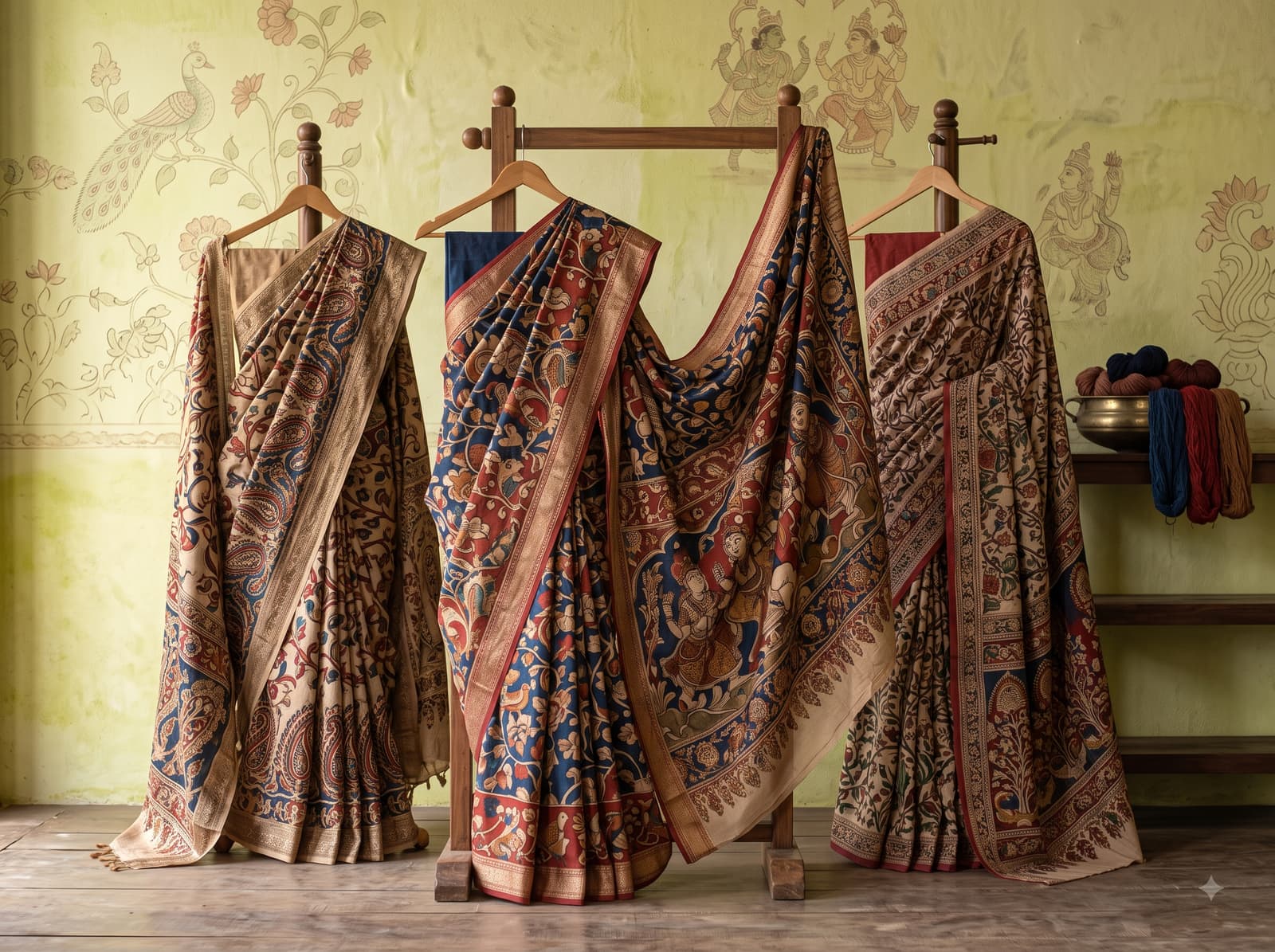
Two towns that share a name
Kalam-kari means pen-work. Two towns in Andhra Pradesh have a claim on the word, and they work in ways that have almost nothing in common. Working out which of them you are looking at is the most useful thing on this page.
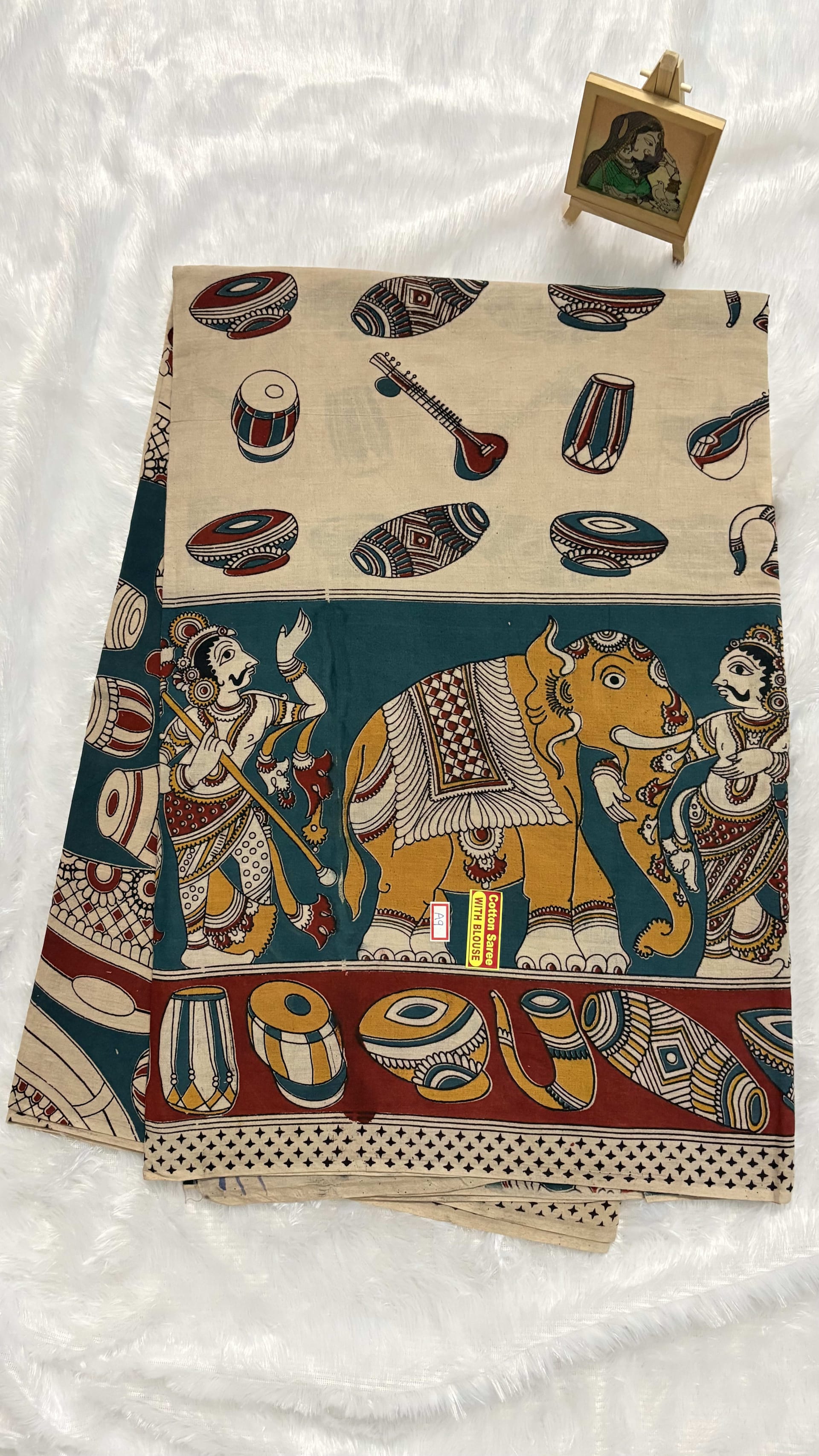
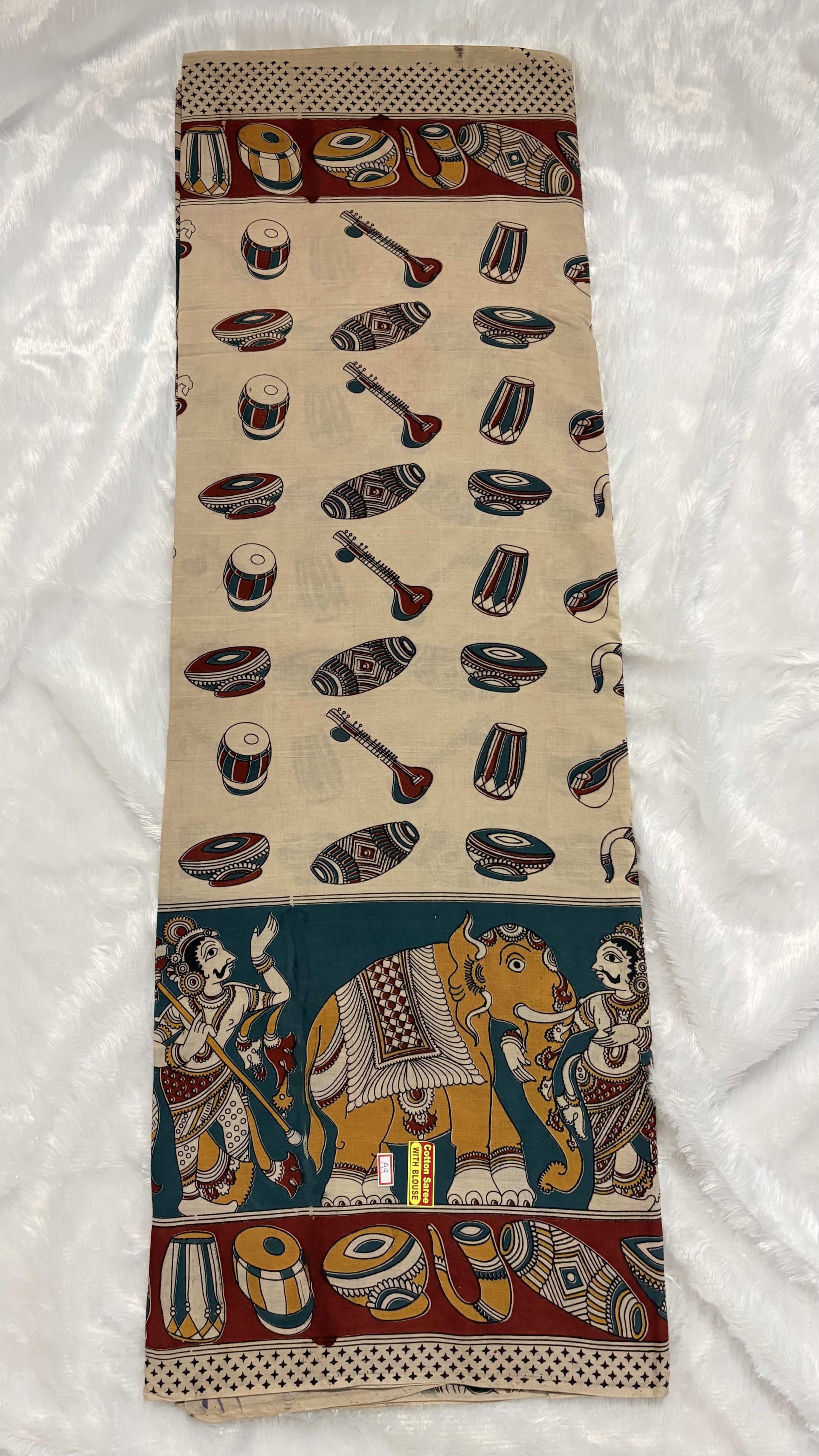
Srikalahasti sits on the Swarnamukhi river, now in Tirupati district, though older references place it in Chittoor. It is a temple town, and the craft grew out of temple use: painted hangings, canopies, chariot banners, and the narrative scrolls carried by the chitrakattis, travelling groups of singers and painters who told the Ramayana and the Mahabharata from a painted cloth. Every mark on a finished piece is drawn by hand with a kalam. There is no block anywhere in it. Srikalahasti Kalamkari was registered as a Geographical Indication in April 2005.
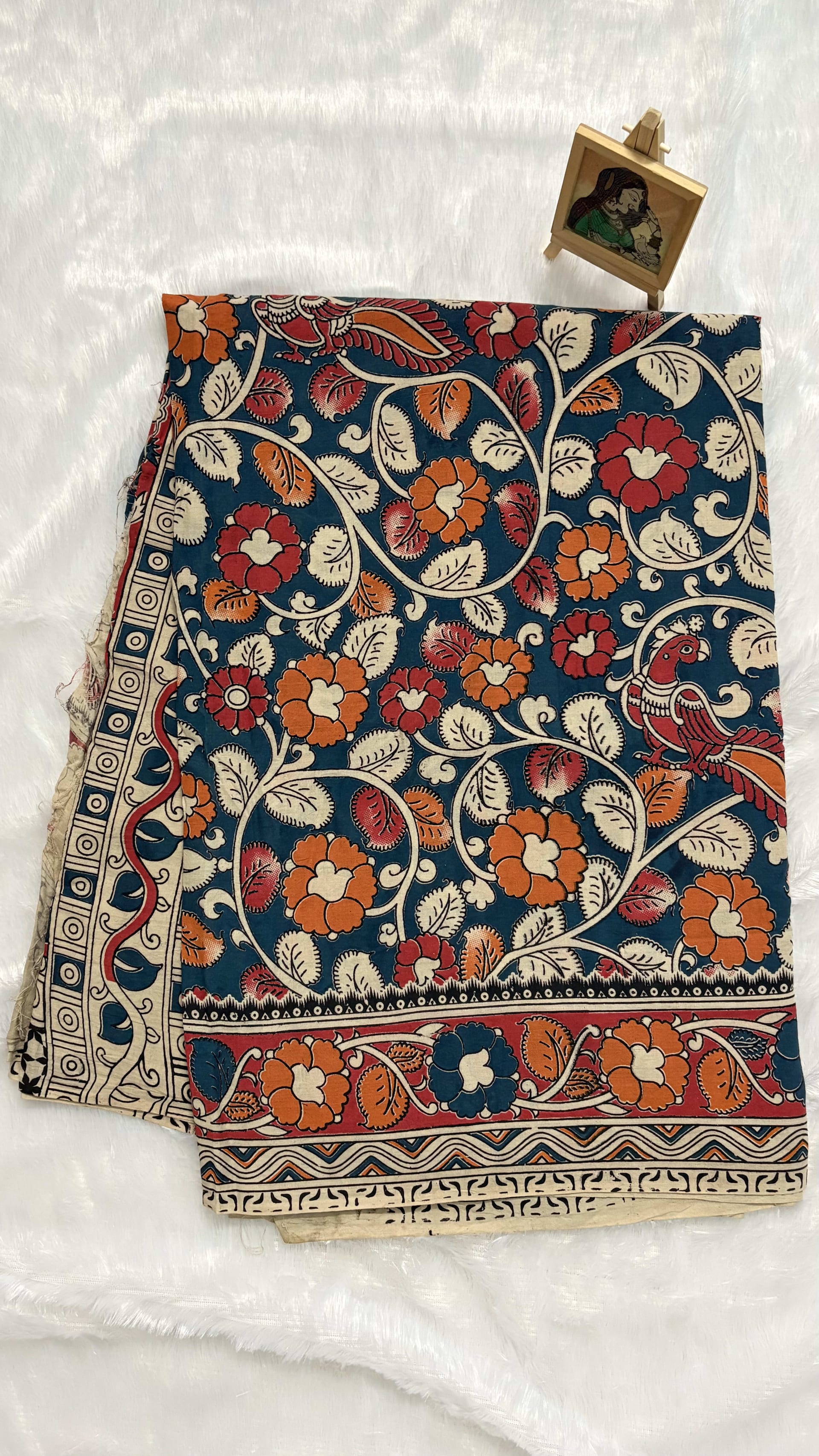
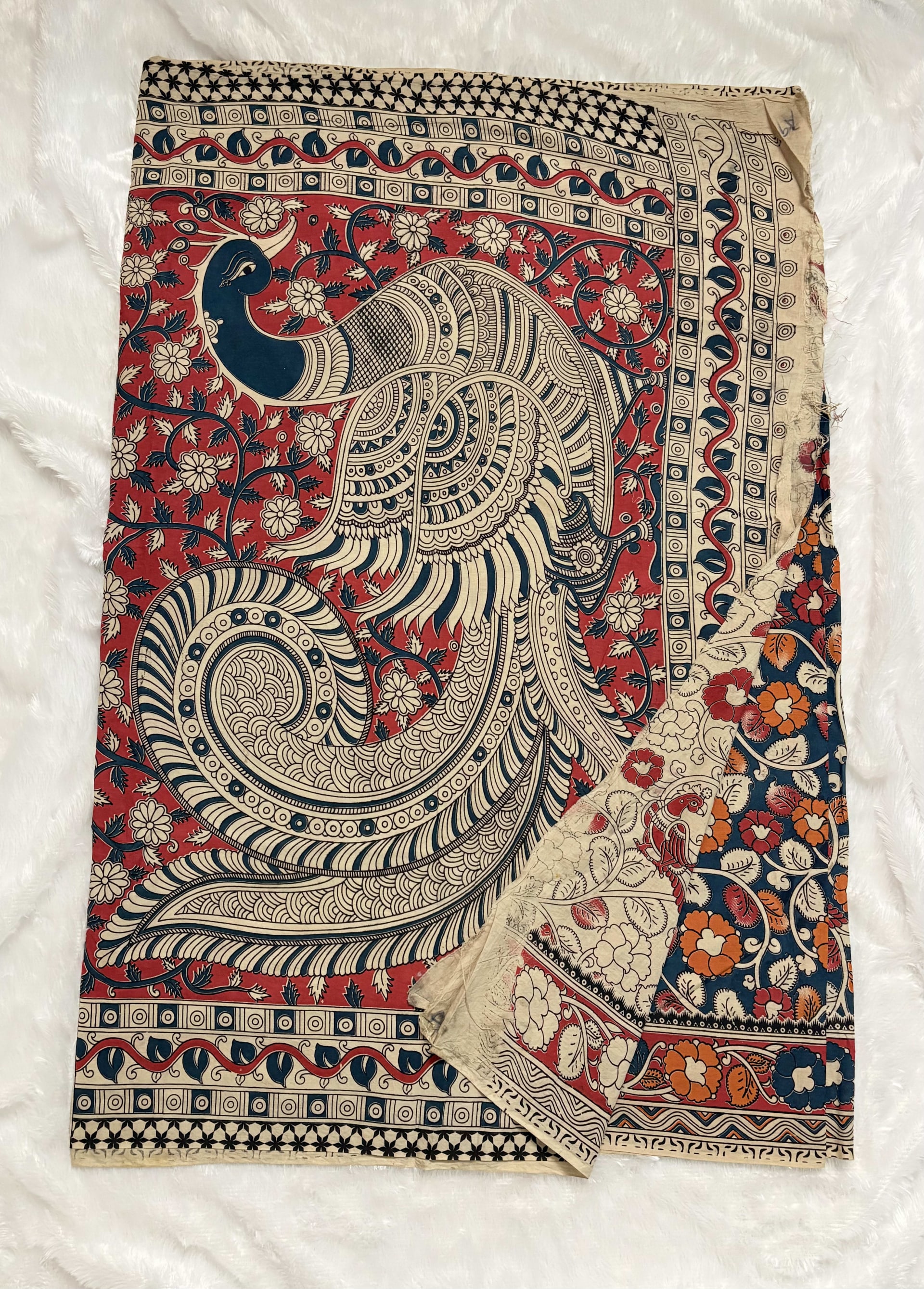
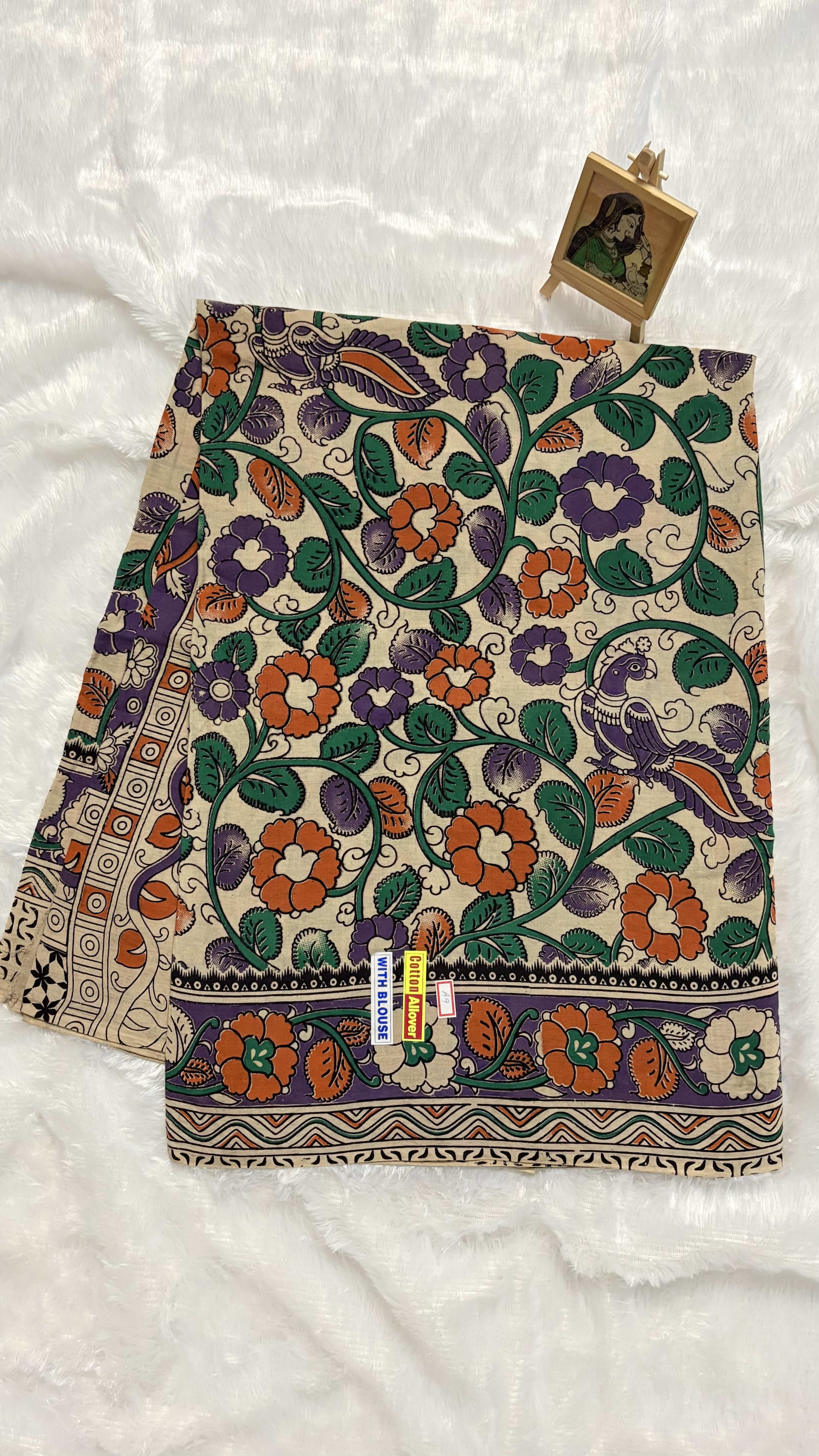
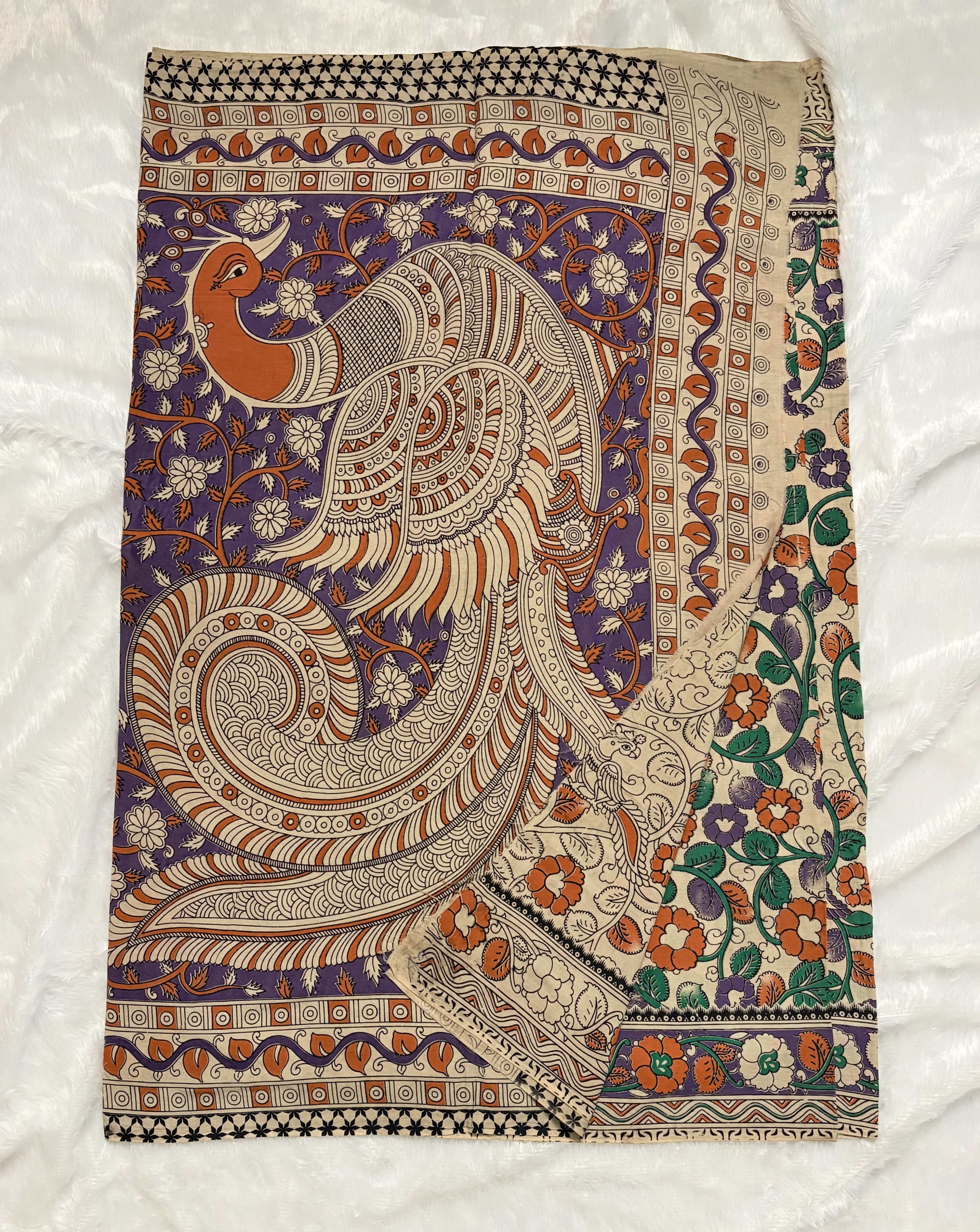
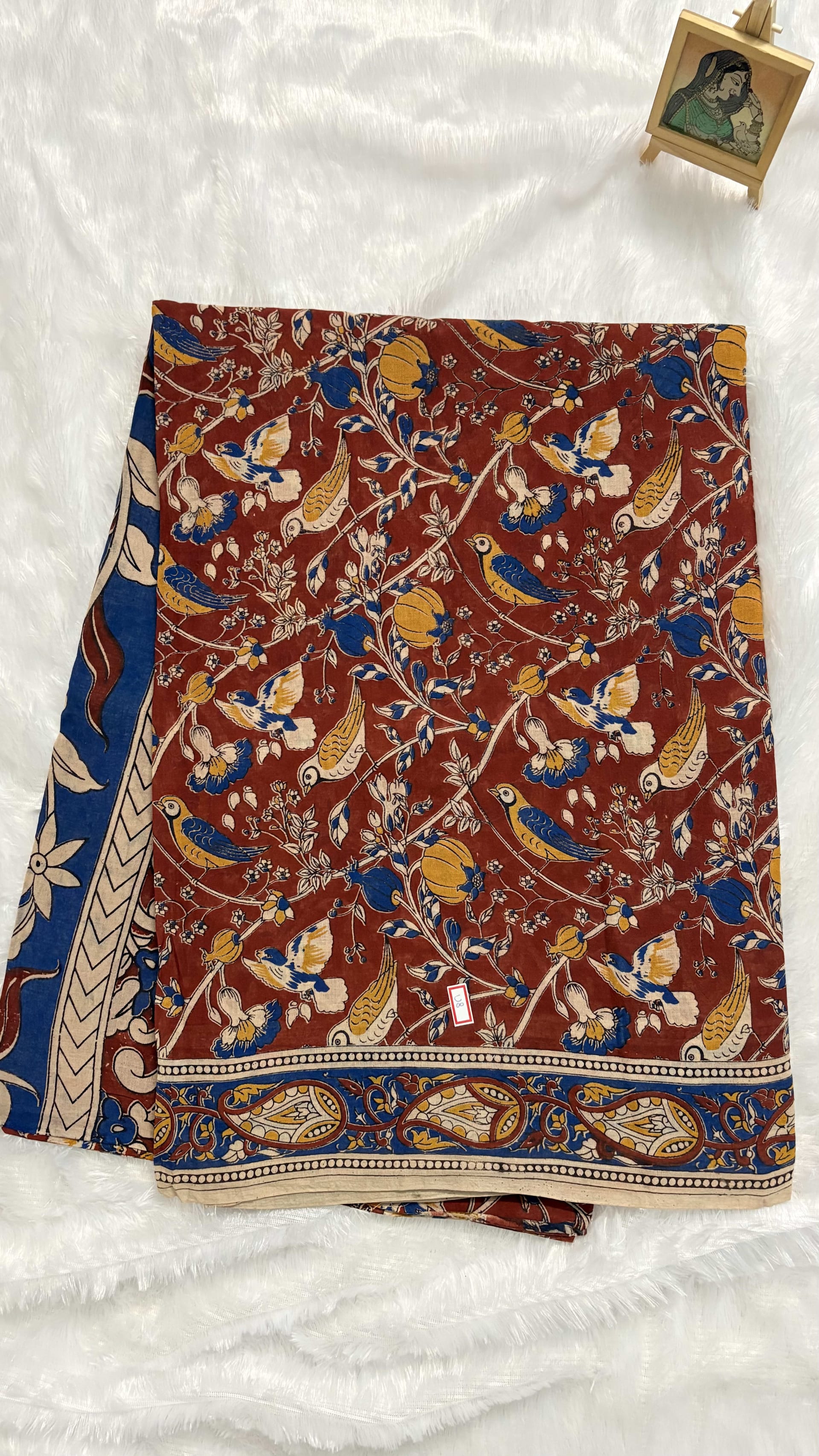
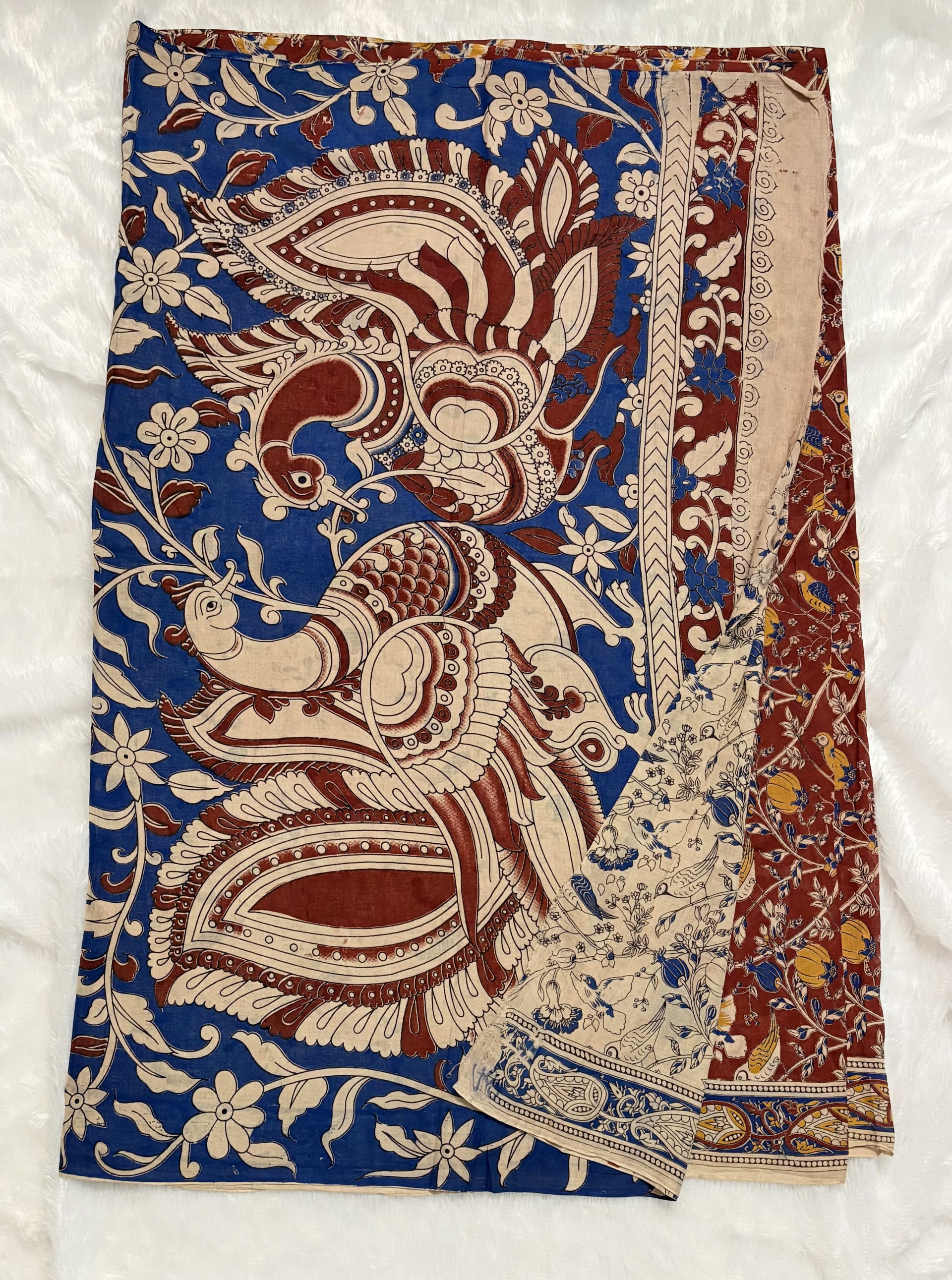
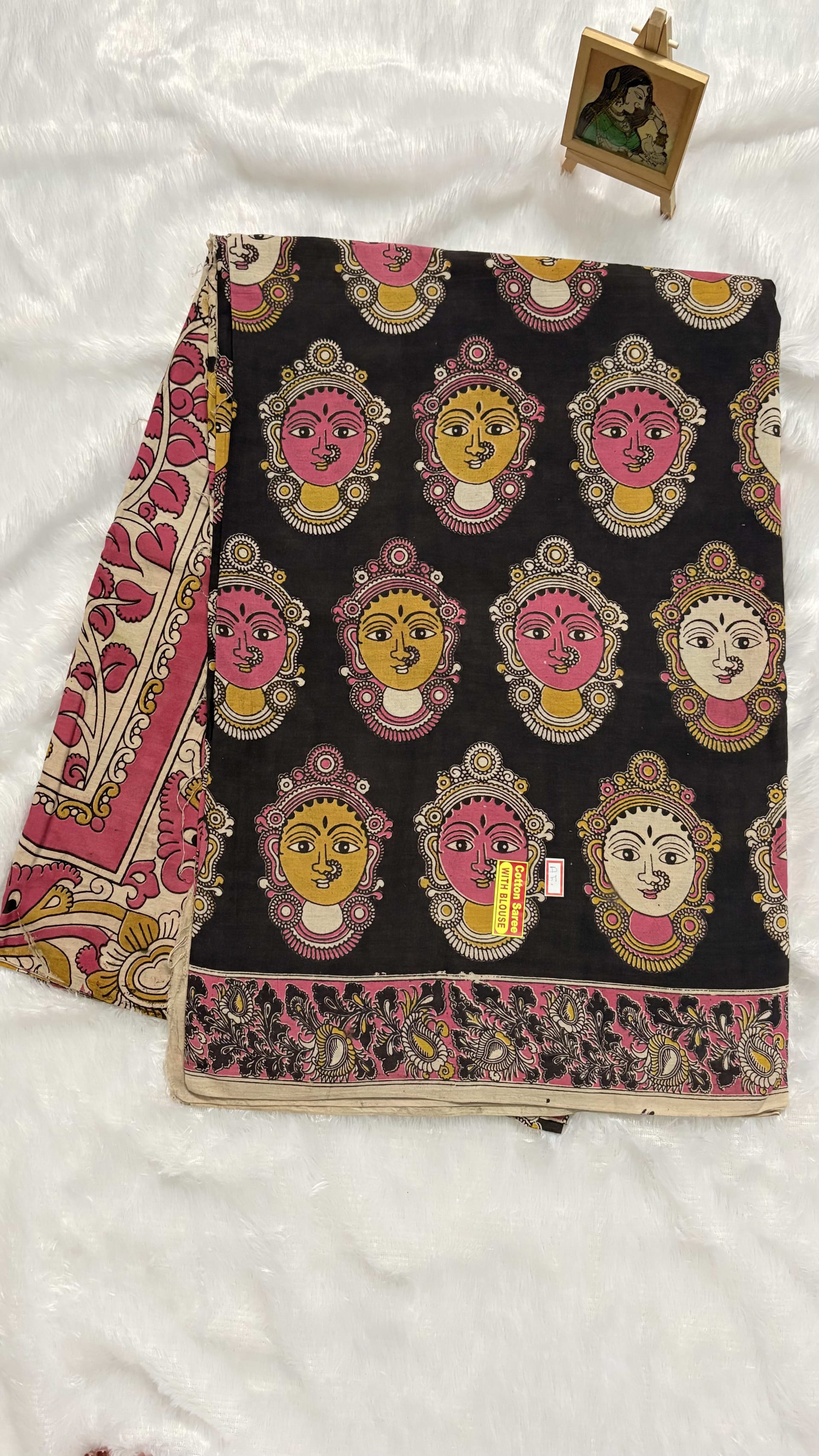
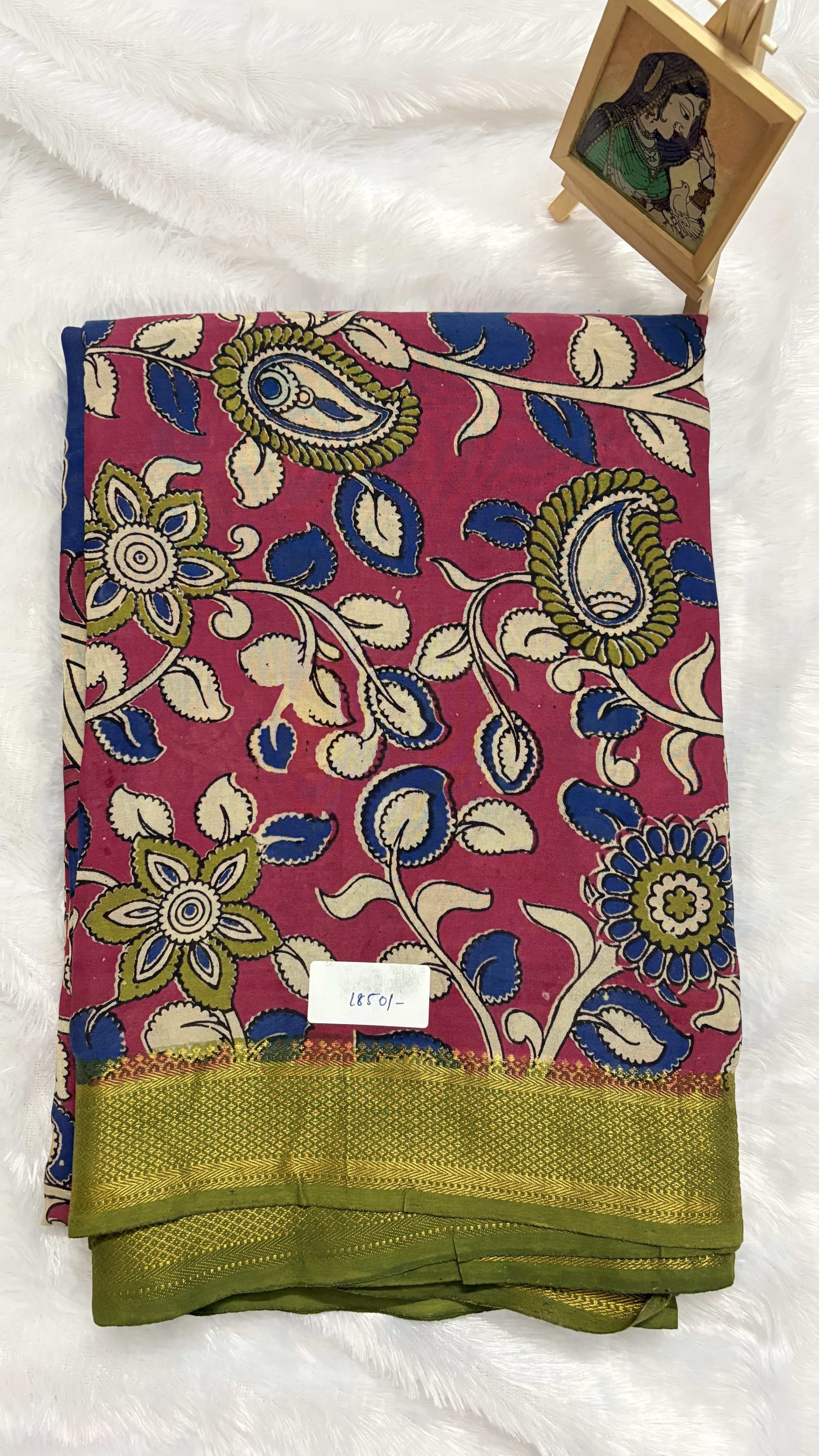
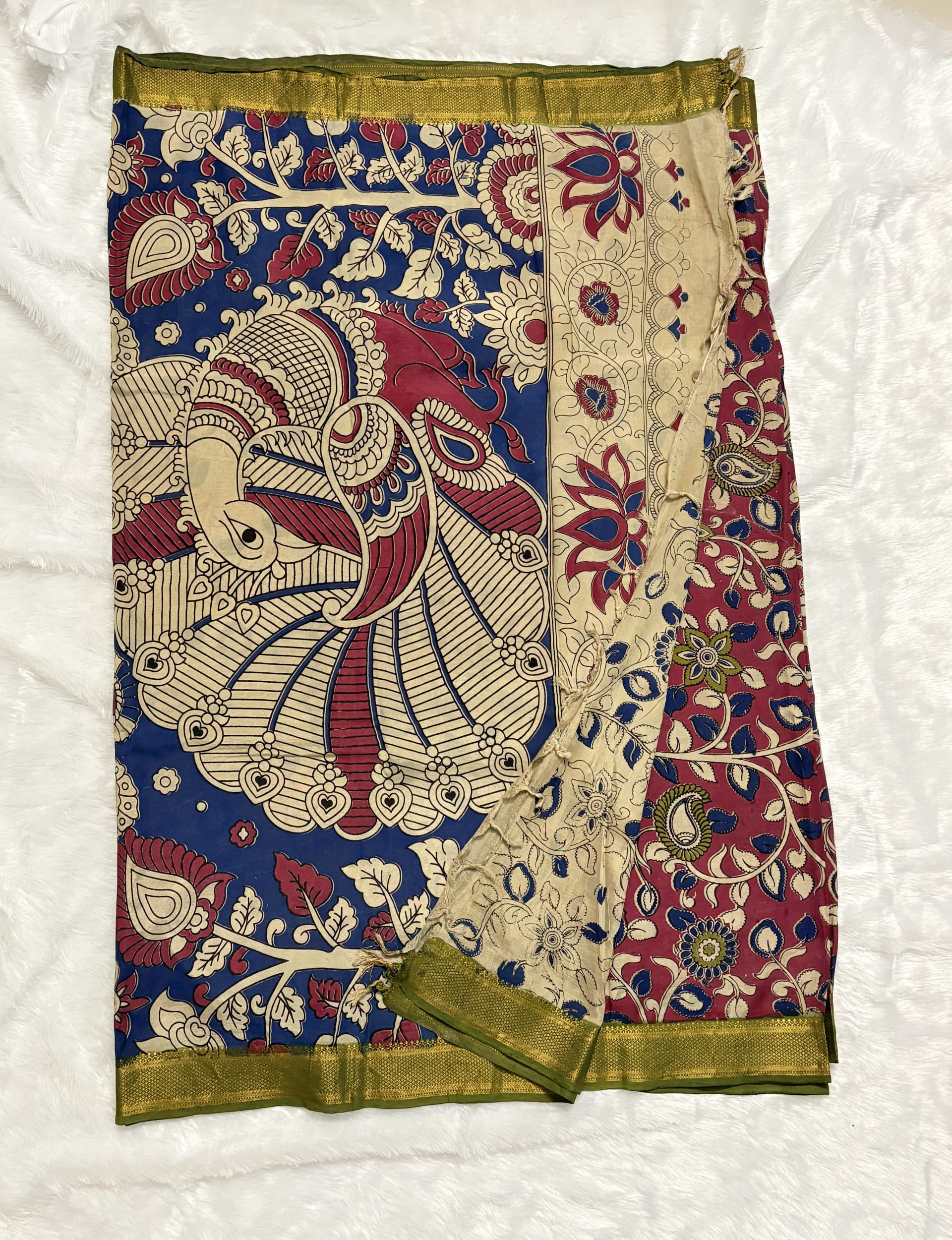
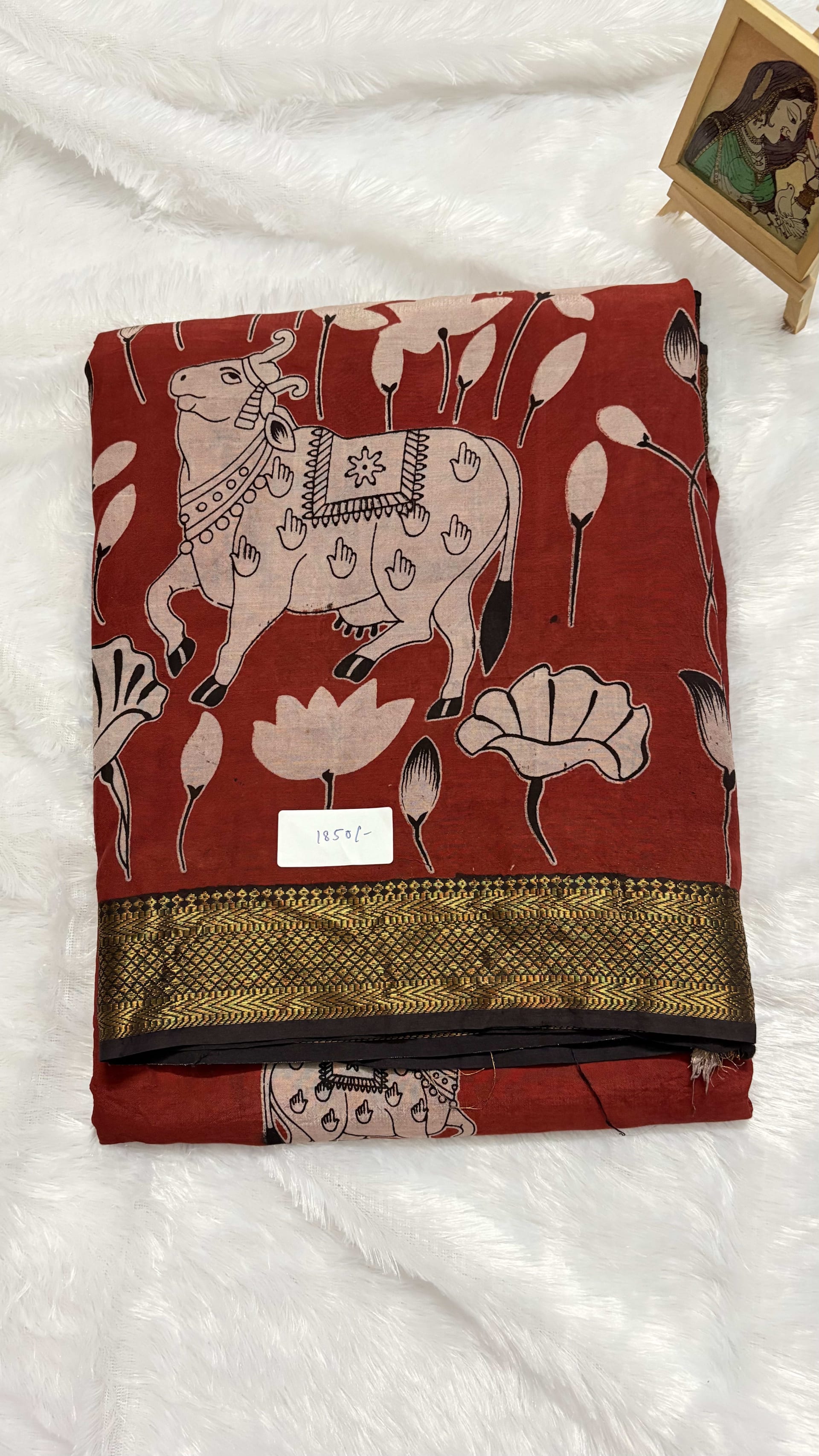
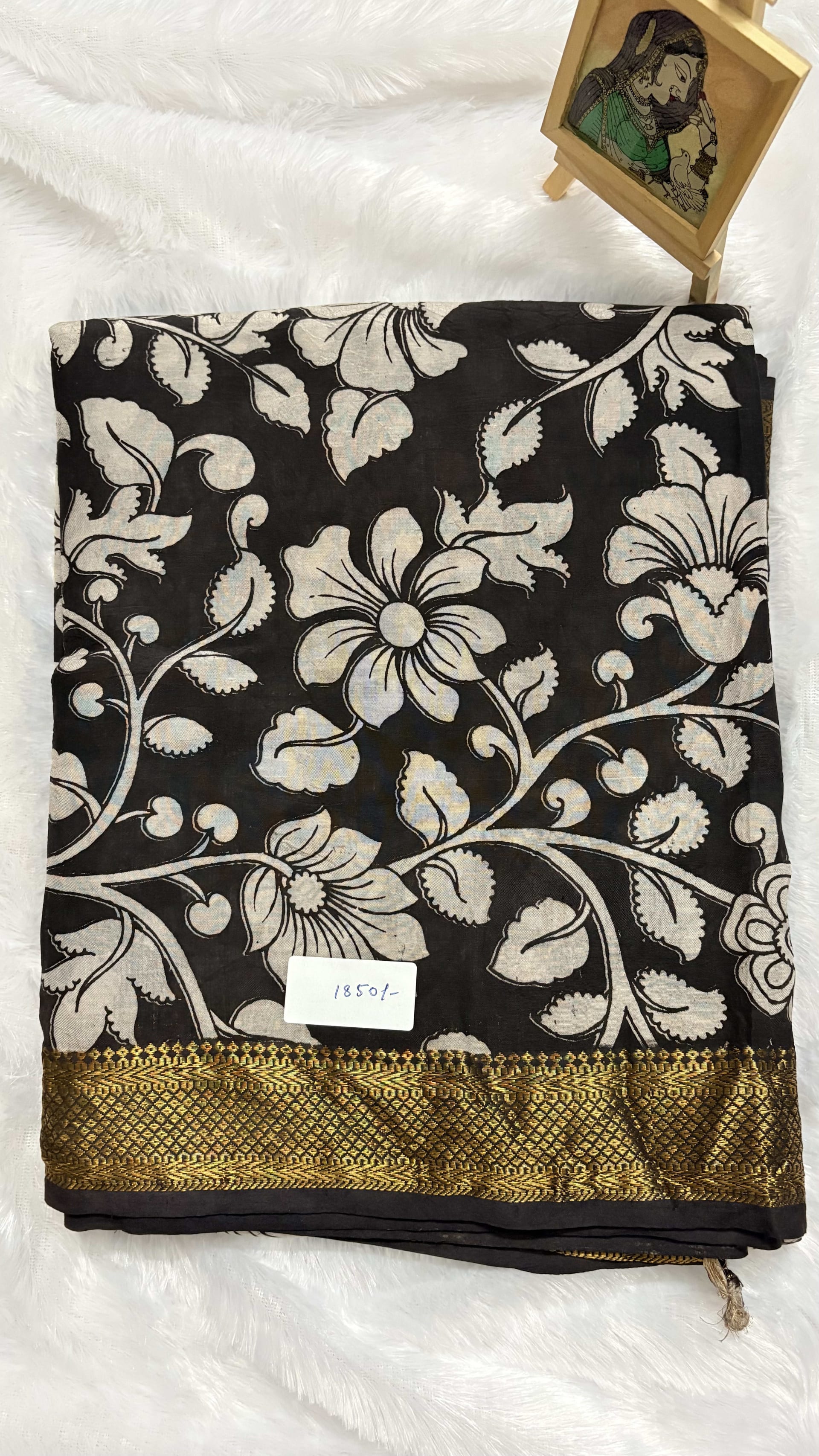
Machilipatnam, in Krishna district, is the other tradition, although its centre of production today is Pedana, about thirteen kilometres away. Machilipatnam was a working port between roughly the fifteenth and seventeenth centuries, trading with Dutch, English and French merchants, and the craft was patronised by the Golconda sultanate and later the Mughals. The designs still carry that history: interlacing leaf and flower, the cartwheel, lotus forms, creepers, parrots and peacocks, Persian in character rather than devotional. Here the pattern is printed from carved wooden blocks. Machilipatnam Kalamkari was registered as a Geographical Indication in April 2008, and the registered production area is unusually narrow, covering Pedana town and neighbouring villages including Polavaram and Kappaladoddi in Guduru mandal, Krishna district.
One tradition painted and devotional in origin. One printed and courtly. Both are Kalamkari, and the common assumption that the printed one is a watered-down version of the painted one is simply wrong.
It begins with buffalo milk
Both traditions start in the same place, and the preparation is half the craft.
The cloth is steeped in a solution of myrobalan, the dried fruit of the Terminalia tree, karakkaya locally, mixed with buffalo milk. Two things happen at once. Myrobalan tannin is what allows the dyes to bond to cotton at all, and the fat in the buffalo milk works as a size, so that colour laid down later stays where it is put instead of creeping along the threads.
The cloth is then dried and washed. It will be washed many more times before it is finished, traditionally in running river water.
Nobody ever sold a saree on the strength of this stage. It is the reason everything after it works.
The pen, and the block
After the preparation, the two traditions part company.
Srikalahasti. The kalam is a bamboo or date-palm stick with a wad of fine hair or wool bound near the point. The wad holds the liquid and the artist squeezes it to release a controlled flow. Black outlines go down first, drawn with kasim karam, an iron solution made by fermenting iron filings or scrap iron with jaggery and water in earthen pots for weeks. Alum is then painted by hand onto every area meant to become red. The cloth is boiled with alizarin from madder root, and the red develops only where the alum was laid down. Blue is indigo. Yellow comes from pomegranate rind or myrobalan flower. Between each stage the cloth is washed and sun-dried. Documentation of the Srikalahasti process counts twenty-three to twenty-five steps of dyeing, bleaching, drawing, washing and ironing, and a single length commonly takes two to three weeks.
Machilipatnam. Identical chemistry, different application. The design is carved into teak blocks, one block per colour, and printed onto the prepared cloth by hand, each colour registered against the last by eye. Fine detail is still filled in with the kalam. The sequence is shorter, a minimum of about ten steps, but it is dye rather than paint, and it still takes days rather than hours.
Here is the part most descriptions skip. Most of the colour in a Kalamkari is never applied as colour. It is grown in the cloth chemically, out of mordants painted or printed on beforehand. That is why the process cannot be hurried, and why the result does not wash out.
Ninety per cent of the market is screen print
Screen printing has largely taken over. Reporting from Pedana has put the screen-printed share of what is sold as Kalamkari above ninety per cent, at a fraction of the cost per metre of genuine block work. A gap that wide guarantees imitation, and the imitation is now the default.
Six checks separate them, and not one needs a loupe or a laboratory. They need daylight, half a minute, and enough nerve to ask a direct question.
That last part is where most buyers lose. A screen print is convincing at conversational distance, draped on a stand, under shop lighting, which is exactly the distance at which most sarees are sold. Every check below assumes the cloth is off the stand and in your hands. If you are not allowed to handle it, you have your answer without running any of them.
Ask which tradition it is. Srikalahasti or Machilipatnam. A seller who cannot answer is unlikely to be holding either.
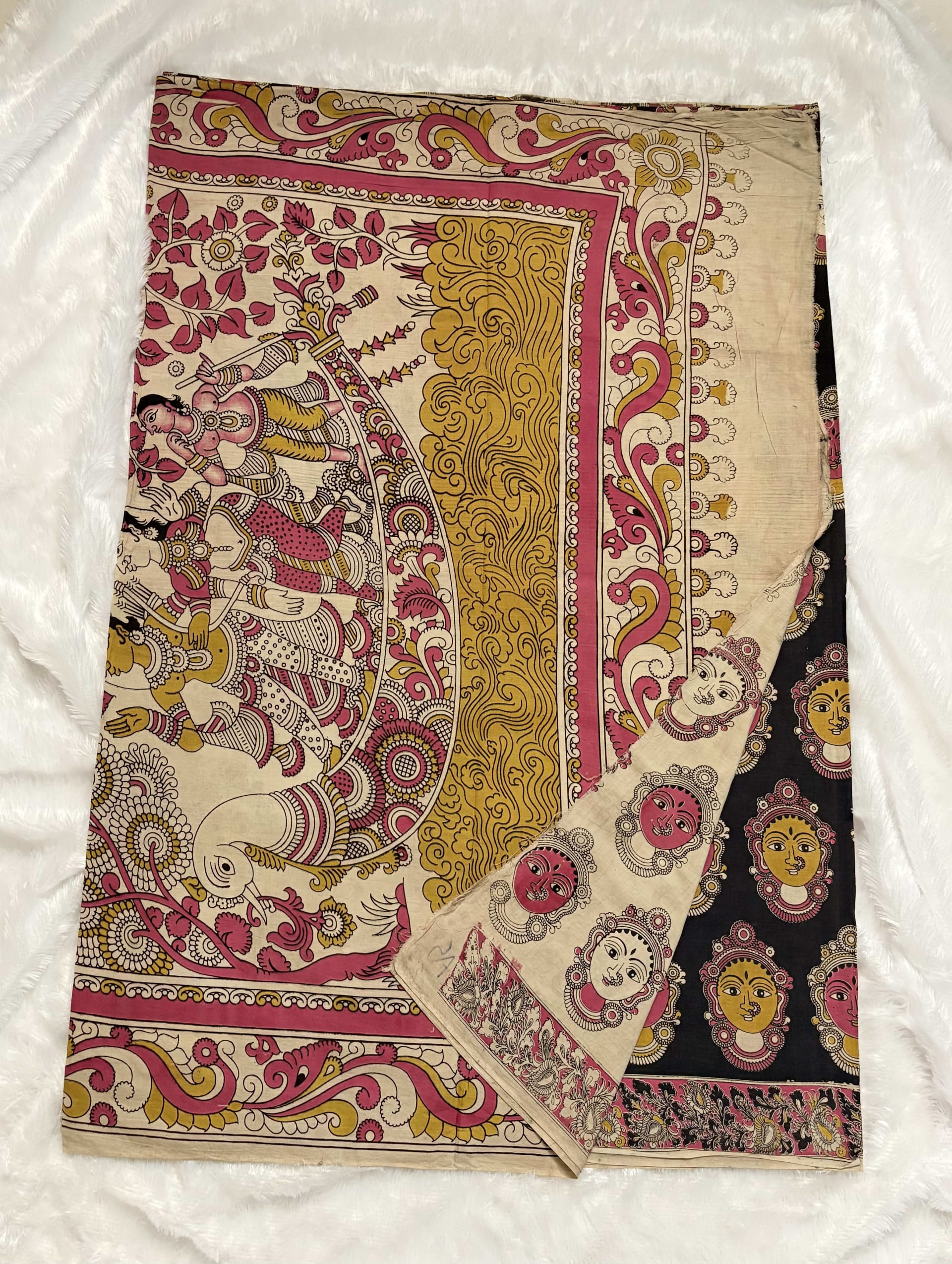
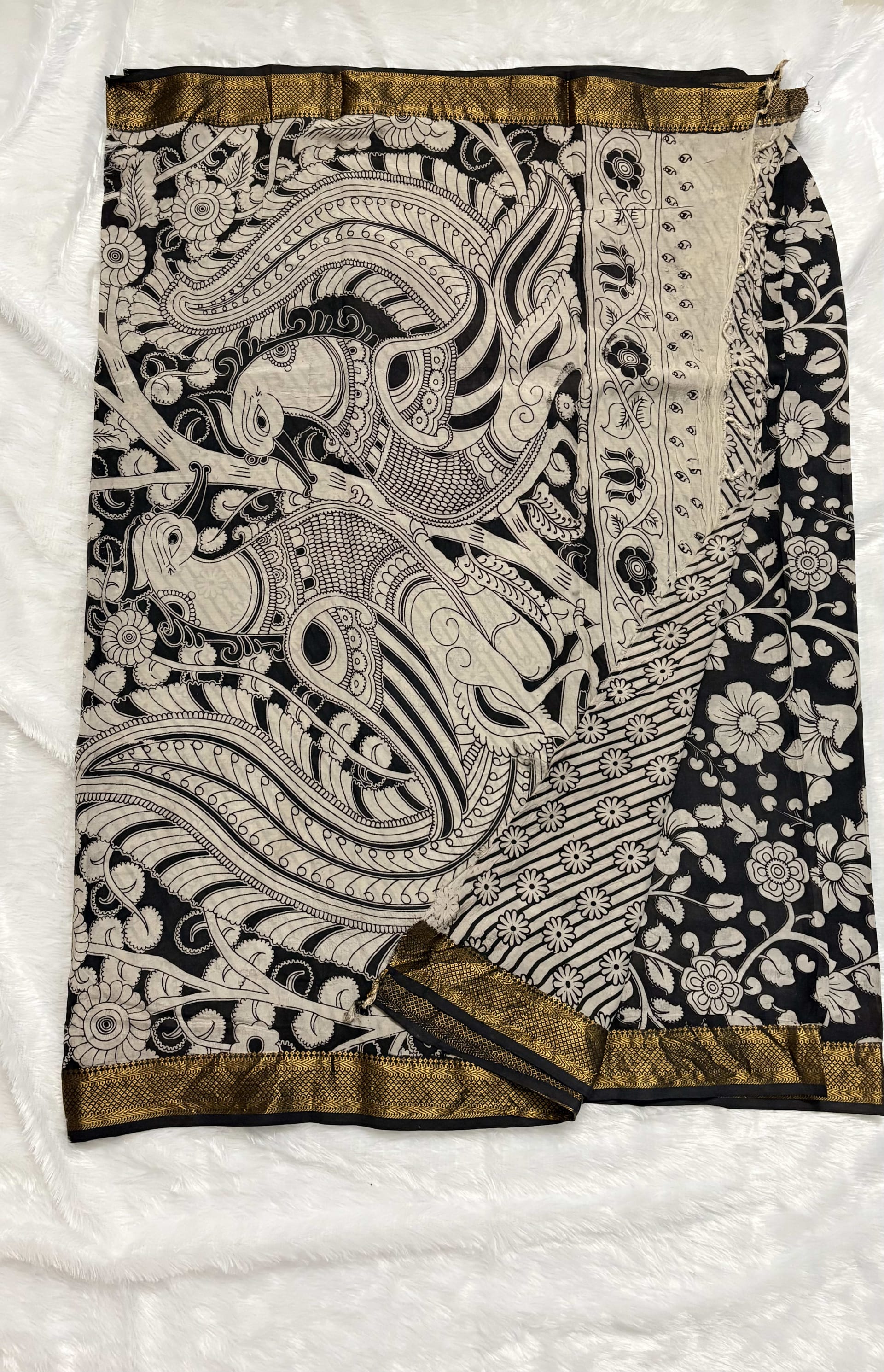
Turn it over. Kalamkari is dyed rather than printed with surface ink, so the colour goes through the cloth and the reverse reads almost as strongly as the front. A screen print sits on top. Its back will be visibly paler, sometimes nearly blank.
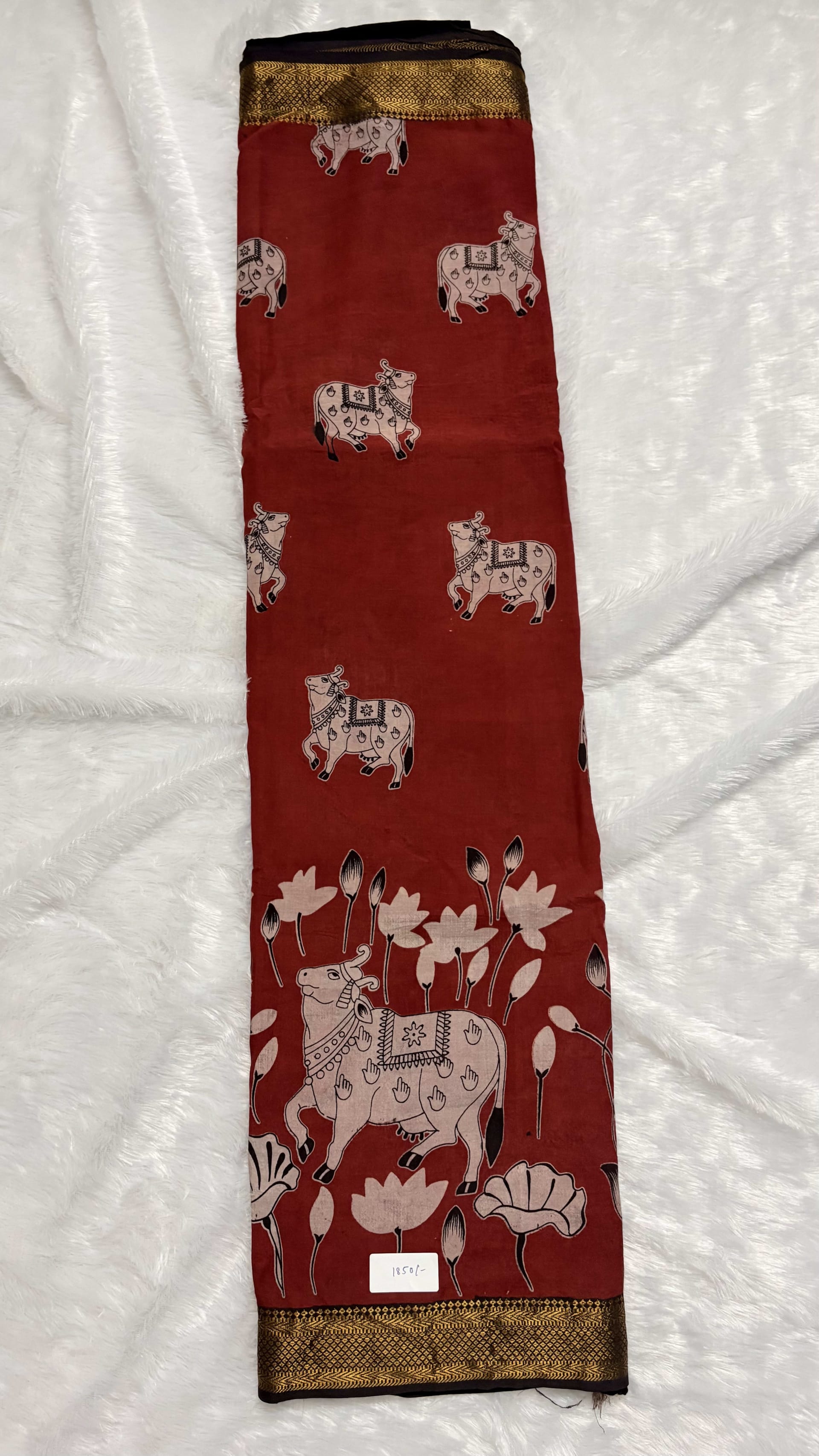
Look for the joins. Hand block printing repeats, and every repeat is laid by hand, so you will find slight overlaps, small gaps, and places where the block landed heavy or light. A screen print runs the full width with no join anywhere. Pen Kalamkari has no repeat at all. Find the same motif twice, identical, on a saree sold as hand-painted, and it was not hand-painted.
Look at the black line. A drawn outline varies in thickness, wobbles, and occasionally overshoots where the artist's hand carried on. Fill colour sometimes strays past it. A printed outline is uniform and closes perfectly every time.
Check the ground and the palette. Natural-dyed Kalamkari sits on an off-white or cream base rather than optical white, and the colours are the ones the process can actually produce: madder rust and red, indigo blue, mustard and ochre from pomegranate and myrobalan, iron black. Fluorescent pink, neon green and bright turquoise are not available from this chemistry. Once you have seen a natural-dyed palette in daylight, this check alone will catch most of what is wrongly labelled.
Smell the cloth. The myrobalan and buffalo milk preparation leaves a distinct earthy smell that persists for a while on a genuinely processed piece. Chemically printed cloth smells of nothing much.
One caveat, and it matters. Block printing is not the fake. Machilipatnam Kalamkari has always been printed and is a protected craft in its own right. The counterfeit is the screen.
The practical position to take is this. On a label, the word Kalamkari now describes a look. Treat it that way until one of these checks tells you otherwise, and you will be wrong far less often than the market average suggests. A seller who welcomes the questions usually has answers ready. One who resents them has told you something too.
Where the money goes
Four things move the price of a Kalamkari, and branding is not among them.
Which tradition. Pen Kalamkari is priced in artist-days. A pallu carrying figures, deities, a narrative panel, faces and hands, is somebody drawing for weeks with a bamboo stick. Block-printed Machilipatnam work spreads the skilled labour across a print run, so it will always sit below comparable pen work. That is arithmetic rather than a compromise.
Number of colours. Every colour is a separate cycle: apply the mordant, dye, boil, wash, dry, and only then start the next. A five-colour piece is not two and a half times the work of a two-colour piece. It is closer to three or four times, because each cycle risks the ones before it.
The blocks. A block-printed design needs a full set of teak blocks, one per colour, cut by a specialist carver. That cost is real, and it is spread over however many metres get printed from it. Short runs and exclusive designs therefore cost more per metre than a design that has been printed for years.
The base cloth. Kalamkari is done on plain cotton, on finer handloom cottons such as Mangalagiri, and on silk. The base sets the floor before a single line is drawn, and silk moves that floor a long way.
Weather comes into it as well. The process needs many washes and sun-drying between stages, so production slows badly in the monsoon and stock is genuinely seasonal.
Be suspicious of a very cheap saree sold as hand-painted Kalamkari. Screen-printed cloth costs a fraction of hand-block per metre, and less than a small fraction of pen work, and at arm's length it looks close enough. That gap in price is the whole reason the fakes exist.
The first few washes decide it
Natural dyes outlast chemical ones over a lifetime and are far less forgiving in the first month.
The first wash. Soak the saree for fifteen to twenty minutes in cold water with a tablespoon of rock salt before washing it. Salt helps settle the surface dye and reduces the chance of it moving onto the lighter areas of the same saree.
Wash it alone. For the first three or four washes, on its own, in cold water with a mild detergent. No bleach, and nothing containing optical brighteners, which attack a natural dye faster than almost anything else in a laundry cupboard. Some colour loss early on is normal and is not a defect.
Do not wring it. Press the water out between the folds of a dry towel. Twisting a hand-drawn cotton distorts the cloth and can crack the outline where the dye is heaviest.
Dry in the shade, inside out. Sunlight is the main enemy of a natural dye. Indigo and the yellows go first. Never dry a Kalamkari on a sunny terrace, however tempting that is.
Iron on the reverse. Low to medium heat, with a thin cotton or muslin cloth between the iron and the fabric. A hot iron taken straight to the painted or printed surface is how people ruin these.
If the base is silk, ignore all of that and have it dry-cleaned, telling the cleaner it is natural-dyed.
Store it folded in a cotton or muslin bag, never sealed in plastic, and refold it along different lines two or three times a year so a permanent crease never sets. Kept out of the sun, a Kalamkari mellows rather than dies. The colours soften into each other over years, which is exactly what a chemical print never does.